


At ten or eleven years old, Dr. Hector Salazar watched his grandmother step off a plane looking dramatically younger than she had a month earlier. She had quietly traveled out of town for cosmetic surgery, healed through the swelling and bruising in private, and come home presentable.
That moment redirected a kid who, a few years earlier, had been caping the family dog like a bullfighter — toward seventeen years of training that would make him a board-certified plastic surgeon.
Monique talks with Dr. Salazar about the long road from medical school to general surgery training in Chicago to plastic surgery at Baylor College of Medicine in Houston, inside what he describes as the largest medical center in the world.
He explains why training as a general surgeon first — including the fifty to sixty kidney transplants he participated in — makes him a more well-rounded plastic surgeon, and where that background stops being useful in aesthetic work.
The conversation covers oral boards (defending a year's worth of his own cases in front of a room of senior plastic surgeons), the legal-household upbringing that shaped his approach to safety and compliance, and why he returned to San Diego in 2015.
He also shares what really happens in a consultation at LJCSC, and why he tells anyone who arrives with someone else's surgical plan that the only goal that matters is theirs.
Links
Meet San Diego plastic surgeon Dr. Hector Salazar-Reyes
Read real patient reviews from La Jolla Cosmetic Surgery Centre
Questions answered by this episode
- Who is Dr. Hector Salazar-Reyes?
- Where did Dr. Hector Salazar-Reyes train as a plastic surgeon?
- How many years of training does it take to become a board-certified plastic surgeon?
- What is the difference between an integrated and a traditional plastic surgery residency?
- Why does board certification matter when choosing a plastic surgeon?
- How does a general surgery background prepare someone for plastic surgery?
- What happens at the plastic surgery oral board exam?
- What should I expect at a plastic surgery consultation in San Diego?
- Is it normal to get a second opinion before plastic surgery?
- How do I find a safe, board-certified plastic surgeon in San Diego?
About this podcast
Learn from the talented plastic surgeons inside La Jolla Cosmetic Surgery Centre, the 12x winner of the San Diego's Best Union-Tribune Readers Poll, global winner of the 2020 MyFaceMyBody Best Cosmetic/Plastic Surgery Practice, and the 2025 winner of Best Cosmetic Surgery Group in San Diego Magazine's Best of San Diego Awards.
Join hostess Monique Ramsey as she takes you inside LJCSC, where dreams become real. Featuring the unique expertise of San Diego's most loved plastic surgeons, this podcast covers the latest trends in aesthetic surgery, including breast augmentation, breast implant removal, tummy tuck, mommy makeover, labiaplasty, facelifts and rhinoplasty.
La Jolla Cosmetic Surgery Centre is located just off the I-5 San Diego Freeway at 9850 Genesee Ave, Suite 130 in the Ximed building on the Scripps Memorial Hospital campus.
To learn more, go to LJCSC.com or follow the team on Instagram @LJCSC
Watch the LJCSC Dream Team on YouTube @LaJollaCosmeticSurgeryCentre
The La Jolla Cosmetic Surgery Podcast is a production of The Axis: theaxis.io
Theme music: Busy People, SOOP
Announcer (00:00):
You're listening to The La Jolla Cosmetic Podcast with Monique Ramsey.
Monique Ramsey (00:06):
Welcome everyone to The La Jolla Cosmetic Podcast. I'm your hostess, Monique Ramsey, and today we're going to meet one of our amazing board certified plastic surgeons. My guest today is Dr. Hector Salazar. Welcome back to the podcast, Dr. Salazar.
Dr. Salazar (00:20):
Thank you so much, Monique, and thank you so much for that introduction of an amazing board certified plastic surgeon. Thank you. I really appreciate that.
Monique Ramsey (00:29):
Well, you've earned it. So I'm always fascinated to know how somebody decides to choose a career. And so tell us about when did you first know that you wanted to be a physician and then maybe into plastic surgery?
Dr. Salazar (00:45):
I have a quite unique, I would say, inspirational story to share with you because as you go through medical school and then you have some different rotations and then you go into either general surgery and then you go through all the different specialties of within or subspecialties within general surgery, you get to experience different things. You become inspired. Then you say, "Oh, I love my transplant rotation or I loved my thoracic or any other subspecialty or plastic surgery as you get exposed to it. " All the way from the beginning, I knew that I wanted to do plastic surgery. And as you know, plastic surgery has different ... You can either practice plastic surgery hand, you can practice plastic surgery burns, you can practice plastic surgery, craniofacial, cleft lip and palate and all those things, or you can do breast reconstruction. I mean, so there are multiple areas within plastic surgery, one of which is cosmetic surgery or aesthetic surgery.
(01:46):
And that I knew right off the bat, I would say I was around 10, 11 years old and we went and picked up my grandma from the airport and the first thing I noticed is that she looked much younger than when she left and that impacted me. And as you know, kids, right? They always, always tell the truth. And I voiced it up. I said, "What happened to you, grandma, that you left looking older and then now you look much younger. You look good." And so she took the time to explain to me exactly what she had done and we went over some pictures because she left for a full month of recovery and by the time she came back, she was fully recovered.
Monique Ramsey (02:32):
Yeah, so she was presentable.
Dr. Salazar (02:34):
She was presentable, exactly. She was not like ... And that period of time that we all know, and we tell patients that you got to be patient, you got to make sure that all that result matures. And yeah, she was looking great and she told me what she had done and then that pretty much opened my eyes. And before that, I always said that I wanted to become a ... I had a couple of periods when kids want to become astronauts or so until I think up to the age of three or four, I wanted to be a bullfighter and I would get a towel and make it a cape. And apparently I was simulating bullfighting some dogs and I barely have memories of that, but that's what my parents told me. There are even a couple of pictures of me bullfighting a dog with a cape and-
Monique Ramsey (03:35):
We need this picture for the show notes, Dr. Salazar. You brought it up. I'm just going to be here to hold you accountable.
Dr. Salazar (03:41):
They probably have vanished with time or they were printed in papyrus or something like that. But then after that, I think for some time I was entertaining the idea of becoming a dentist, but by the age of 10, 11, I pretty much knew what I wanted to do. And since then, I would say that I focused all my efforts, all my efforts in becoming a plastic surgeon. So I went through medical school understanding and knowing that I wanted to become a plastic surgeon. And then as I was going through that training route that I'm a fully trained general surgeon and back during the time that I trained, very few programs were integrated programs. So nowadays if you want to become ... The great majority are integrated now. So if you say, "I want to become a plastic surgeon," then you go into plastic surgery right after you finish medical school.
(04:39):
So you know that you're in there for six years training, doing some general surgery rotations and then transitioning into plastic surgery. In my case and during my time, the great majority of programs were not integrated. So you would finish your full five years of general surgery, become a general surgeon, and then do three additional years of training for plastic surgery. So there's a total-
Monique Ramsey (05:06):
That's a long time.
Dr. Salazar (05:08):
Total of eight years plus a couple of years of research-
Monique Ramsey (05:11):
Plus your MD.
Dr. Salazar (05:12):
Plus you're right, the MD plus. So 17 years after I left high school.
Monique Ramsey (05:17):
Oh my gosh.
Dr. Salazar (05:18):
It takes some time for you to say that you're a plastic surgeon.
Monique Ramsey (05:22):
Yeah. And so a general surgeon or what is like gallbladder removal or what kinds of things does a general surgeon do? Is there anything that kind of helps you on your way to being a plastic surgeon or is it kind of not too specific?
Dr. Salazar (05:35):
Going through general surgery makes you a very well rounded surgeon. You gain a lot of confidence, you take care of critical care, very ill patients ranging from patients that are going to get a liver transplant, patients that are sick because they have pertonitis, meaning an infected abdomen. In addition to that, you do a lot of trauma surgery. So as you know, the way trauma services work around the country, you have to train at a level one trauma center where you get the sickest of the sick, anywhere from gunshot wounds to motor vehicle collisions to stab wounds and that team is led by a general surgeon. And as you're going up the pyramid of training, at some point you are a chief resident, meaning you are a fifth year and then you're basically leading that team during the acute phase of the trauma. Always you're being overseen by a trauma surgeon, but in reality, in a training institution, a training setting, the person that's leading immediately or executing every single step is the chief resident.
(06:52):
And it's a lot of responsibility, but really you develop a thick skin and you develop a lot of confidence and you develop a lot of discipline and skills in treating your patients and taking your patients to the operating room determining and it's really important when there is a problem, how soon to take care of it, when to be conservative, when to be more aggressive, when to just give some antibiotics and observe and that doing that for five years in general surgery gives you many weapons that you're going to have in your armamentarium to treat a patient. That being said, our patients in plastic surgery, if they're really sick, we're not going to operate on them, especially in the cosmetic and aesthetic world. So in those regards, it's like you're getting an overqualified plastic surgeon that knows how to treat all this critical care ill patients that now we're treating only healthy patients.
(07:56):
And also let's say that general surgery, you're going after a different goal, meaning you need to save the patient's life so there's not going to be a lot of finesse and you're not going to have-
Monique Ramsey (08:10):
You don't have to make it pretty.
Dr. Salazar (08:11):
You don't have to make it pretty. You try to do your best when you're closing an incision, but if the patient is really sick and the next thing that you need to do is get the patient out of the operating room to an environment when the patient can be monitored and recover better, sometimes the closure has to be, I mean, it's very quick and life saving surgery and that's why when you transition from being a highly trained general surgeon into the plastic surgery world, then things have to be reshaped and changed. So yeah, removing a colon or removing an appendix doesn't give you a lot in terms of that finesse or in terms of that care, but at the same time, I think it's an integral part of the overall how well rounded a plastic surgeon can be.
Monique Ramsey (09:02):
And so after that general surgery phase, let's call it, then you say, "Okay, I want to go into the plastic surgery side." And you did that in Houston, am I right?
Dr. Salazar (09:13):
That's correct. And since we are having this nice conversation, let me share this with you. In the world of general surgery, I mean, we're all colleagues, we're all surgeons, but general surgeons, I mean, I just explained to you at which level they function and what are their goals and different approaches to do things. So plastic surgery is seen like maybe a specialty that it doesn't ... I mean, a pancreatic surgeon would think that, "Oh my God, this guy's our only skin and fat surgeons." We get the same way that we say you lack a finesse and they say like, "Oh, come on. We are dealing here with ... We feel the aorta in our hands and well, we are putting a breast implant."
Monique Ramsey (10:01):
Do they see it like as a step down in a way?
Dr. Salazar (10:04):
Well, maybe during training, but I bet you that they, I think secretly they like what we do.
Monique Ramsey (10:12):
It's way more fun, right? It's got to be more fun.
Dr. Salazar (10:15):
So I was blessed that in the program where I train, I did my internship at University of Illinois, metropolitan group of hospitals over there, you didn't have to disclose that much special in your first year, what are you going to do for surgery in terms of are you going to become a general surgeon? Are you going to pursue anything differently so you don't have to disclose that much. I then transferred from Chicago. I moved to Houston to continue my general surgery training my second, third, fourth, and fifth year over there. But by the time I came in and particularly because I already did research for Baylor College of Medicine for my postdoc research fellowship in plastic surgery, everybody knew at the hospital that I was very much interested in plastic surgery. And again, in order for you to apply and become a plastic surgeon because it's a highly competitive specialty, you have to be functioning at a very high level in your general surgery training.
(11:15):
Just think about this, you have to have good grades, right? You have to have good performance. You have to have good letters of recommendation of the people that you're working with in order for you to be competitive enough and you have to have some publications, you have to have some research. And so you have to be a stellar resident in order for you in your program in order for a plastic surgery program to consider you as someone that should or deserve to be trained as a plastic surgeon.
Monique Ramsey (11:44):
What age are you as you're about to go into this plastic surgery?
Dr. Salazar (11:48):
31, 32 probably. I'm dating myself here.
Monique Ramsey (11:52):
No, but 20 years of thinking about like, this is what I want to do. And all of a sudden it's that moment, right? And it's like, oh God, they have to take me.
Dr. Salazar (11:59):
And meanwhile, you're taking out an appendix and you're like, oh my God, this has nothing to do with that beautiful facelift that I saw at home. But then once you train in plastic surgery, and then I was very close to the plastic surgery division in Houston where I trained. And actually I was very close to all plastic surgery programs in Houston. There was actually three different plastic surgery training programs in Houston. It's like Houston
Monique Ramsey (12:27):
Is like- It's like the Mecca.
Dr. Salazar (12:28):
The Mecca is the largest medical center in the world. And literally the first time I saw it, because before I went to Houston to go and rotate at Baylor College of Medicine as a medical student, when I got there and I looked at the size of the medical center, I thought it was downtown. Literally, I don't know if you visit the medical center.
Monique Ramsey (12:49):
I've only been once. I was over by MD Anderson, but I was in and out in a day, so I didn't really get the full scope of the city.
Dr. Salazar (12:56):
I looked at the medical center. I thought it was downtown, but then I was like, no, no, downtown's over there. So what you're looking at are only hospitals and the largest VA in America, the largest private hospital in the world, which is Methodist Hospital, the largest cancer center in the world, MD Anderson. You have two medical schools, University of Texas, you have Baylor College of Medicine, and don't quote me here, but I think it's like two or three nursing schools as well are there and you have all these big research buildings. The greatest part about it is it's not only about quality, but there's also good amount of quantity of ... So if you're interested in support and support, you're interested in a certain procedure, you're going to be able to see it multiple, multiple times over there. I felt, you know what, this is the place where I want to get trained and because our program was heavy, heavy loaded with cosmetic surgery, I would say the next thing was breast reconstruction.
(13:59):
And then we were probably, and we were because the reason why you have to sometimes go and visit other programs, it's because the program where your training potentially does not have enough volume of other things such as, for instance, hand surgery, trauma, hand surgery, the hospitals that we had in our program didn't have enough of that. So we would have to go and visit other programs where that was the forte.
Monique Ramsey (14:27):
Because isn't that part of your ... When you take your boards, you have to answer a whole bunch of questions about micro hand surgery. I mean, even if you're like, "No, I'm never going to do that. " That's part of your test, right?
Dr. Salazar (14:40):
That's part of your test. You're in a room with, imagine all this professors in plastic surgery, they're asking you a bunch of questions that's after you passed your written exam, which it's a very extensive exam and you're answering questions about hypothetical cases and you're also answering questions about your own cases that you have to submit because you collect cases and present and defend them. And there's no way that you can only present, here are my 160 breast augmentations that I did on my first year of practice, you have to collect cases for a year and then you have to go and present a good, nice variety of cases that they ask you for minimums that you have to do a little bit of this, a little bit of that, a little bit of this, a little bit of that. And then you have to be well versed in all of them and you're talking to people that the only thing they do, as you were saying, microvascular surgery or hand surgery, that's the only thing that they've been doing for the last 30, 40 years.
(15:40):
And you have to not only sound smart, but also be able to prove it because you have to show pictures, you have to show your anesthesia records, you have ... That's why board certification, if someone is not passing their boards, it means something. It means something. It's very strong. So it is a long journey, but the story behind it of me knowing all the way all along that I would've do cosmetic surgery. So literally what I'm doing right now is what I-
Monique Ramsey (16:11):
Your life dream.
Dr. Salazar (16:12):
That's my life dream. So that's exactly what I wanted to do. Very passionate about it along the way, learn many other things, how to perform a kidney transplant. I think I participated in more than around 50 to 60 kidney transplantations and I loved it, by the way. I think it's a very elegant surgery and teaches you how to be very efficient, which some of those principles we can apply them, but all those things are just great memories that I have right now and I'm fully dedicated to making the world a better place one person at a time.
Monique Ramsey (16:47):
So Houston and a lot of breast surgery. And then when did you come back to San Diego?
Dr. Salazar (16:51):
2015 is when I came back. As you know, I'm some sort of a hybrid. I grew up over here and a couple of size of the border. Both my parents were lawyers. I grew up like, yeah, exactly listening to my parents talk about legal cases and there's no HIPAA there. You can discuss cases openly. I've been sitting at-
Monique Ramsey (17:15):
That'd be super interesting though, right? I think it would be.
Dr. Salazar (17:18):
Exactly. It's funny.
Monique Ramsey (17:19):
I think it would be fun as a kid to hear like, "Oh, this is so interesting." The world of the adults and then the legal world and what kind of cases come up.
Dr. Salazar (17:28):
Absolutely. I've heard people ask me like, "And why you didn't become a lawyer?" And you know what? Probably I would, I mean, I'm always getting involved in the rules of regulation committee. I'm a counselor for California set of plastic surgeons. I have that little bit in the back of my mind, but I think there were too many lawyers already in the family and we needed a plastic surgeon.
Monique Ramsey (17:50):
Yeah, right. Everybody's got to have one in the family. So coming into practice here in San Diego, you did a lot of breast reconstruction, right?
Dr. Salazar (17:58):
Yeah. As we were talking about it as I came back, I really wanted to come back to San Diego that was not negotiable. That was not an option. You can imagine when people in Texas were like, "Oh my God, Hector, that's going to be fantastic when you go to San Diego, good luck at the same time." Because Texas, California, all taxation and all the, especially for physicians reimbursement and all that, which is a different topic.
Monique Ramsey (18:24):
And there's just a lot of plastic surgeons here. You're jumping into a pond with a whole bunch of competition and being able to distinguish yourself as sort of like being the best of the best is that's harder, but it's also it's your home. And we at Loya Cosmetic, we're glad you came because I think it's one of the reasons we started this podcast was because of you. You and I had a conversation about another one of your favorite topics, which is wine, but you were listening to a podcast about wine and you're like, "Monique, I really think we could do something like this. " And I had been thinking about the podcast for years, but I was like, I don't know how to put it together, like the mechanics of it and just finding a place to have a quiet moment. The center is hard. We don't have a studio, right? But yeah, I'm so grateful that you chose to be part of the practice and to really help us bring ... We've always been a practice that educates patients, so a big belief of ours and safety and those are two of your passions. You're great at educating patients. Thank you. You have wonderful analogies. We always are talking about them in the office. Like your soldiers when you're doing hair transplants-
Dr. Salazar (19:41):
That's right.
Monique Ramsey (19:42):
You got your little army and your little soldiers, but also then having that safety side of you and you've done different parts on the plastic surgery society on the education or safety committee. Can you talk about that for just a moment?
Dr. Salazar (19:59):
Safety is the number one thing. It's above even patient results, safety, right? Because all of our patients are living happy lives, they're walking on the streets, have families and they have to be able to go back as soon as we can release them to resume exercise and go to work and with a smile on their face because now they feel better, they look better. This was a great experience. So that's why safety has to be number one. I've been part of the safety committee of the Aesthetic Society for quite some time. I was very involved in the American Society of Plastic Surgeons at the level of patient education committee, membership committee, that's a different topic. But combining my patient education tendency with my safety loving background, I think that those are two premises that fit pretty well in our practice. I mean, that's what legacy gives you, right?
(20:58):
It reassures you that things have been done adequately in this place. So the only thing that we can do is come in, boost it and continue with that tradition and take it to the next level. And I think that maybe also that comes from that lawyer background of the family that you always want to be compliant, you always want to read the fine print in every sense, right?
Monique Ramsey (21:23):
Yeah. And not taking shortcuts too.
Dr. Salazar (21:24):
And not taking shortcuts.
Monique Ramsey (21:26):
I think that's the other thing is when in any industry where there's a lot of competition, somebody's always trying to get ahead and there's always somebody who's going to take a shortcut to get to be famous of this or that or get well known for something and it's just not worth it because really, how do you stay in business? Like you say, I mean, we're coming up on 38 years so that people trust us because at the end of the day, they could go anywhere. So really giving them that education so that they know that we have the best surgeons that, like I said, amazing certified plastic surgeon, that you're coming with all this knowledge and that helps bring to the group of surgeons here. It's wonderful that you all can share and you and I have a podcast about that, kind of that collegiality of a group practice and we'll put that in the show notes.
(22:19):
So the last question I have for you is what would you want a patient who's listening to take away from this podcast about you? What would you want them to know about you?
Dr. Salazar (22:31):
One thing is pretty much the same way that I'm here having a conversation with you. That's exactly when they come to the office the way that they're going to interact with me. But for patients to know that the main character here, the most important person is the patient is the patient comes in, patient sits down and it's their moment. It's all about them. The only reason why I'm here is to protect them. It's to help them achieve their goals. There's going to be some times that something that they're asking for, we cannot deliver it on a safely matter in one operation, for instance. We might need a couple of operations or in order to get them to the results we need to choose a little bit of a different surgery maybe because sometimes we know the result we want, but maybe we have not received those 17 years of training after high school.
(23:30):
Then therefore that's where my expertise comes in and then you're talking to them about maybe a different procedure that they thought they would benefit from, but it's all about them and that's what the consultation's going to be like. We're just going to sit there. We're going to be listening to their goals extensively. And then after that we examine them and after that we're going to come up with plan A, plan B, plan C maybe, or maybe only plan A, but whatever it is, we would only recommend something that would definitely benefit them and that they are going to feel and look better.
Monique Ramsey (24:07):
Yeah. Not operating just to operate, not operating for the paycheck. I think the ethics of it really come through with all the surgeons at La Jolla Cosmetic Surgery Center and with you, I always get that. I never feel like you were just in it for like, "Oh yeah, I want to get to my hundredth, whatever." You're very sincere about if it's going to help you, the patient.
Dr. Salazar (24:33):
Exactly. I always tell patients, because sometimes they say, "Well, I've been to this consult, that consult, and they also wanted to add this, this, and that. " And I said, "Are you interested in adding that? " Because potentially we can, but maybe that's not going to ... I mean, as we're interpreting your goals, definitely we can get you there without that. But some patients say, "Well, I was told that if I don't go for that, they're not willing to operate on me. " And I'm like, "Well, it's all about you. It's not about me. It's not about delivering the result I want to deliver. It's delivering the result you want to have. " And I think that sometimes, I mean, of course my main goal is to have patients that are satisfied and then get a nice five star review.
Monique Ramsey (25:19):
And we do and we do. And I'm going to put in the show notes a link to the five star reviews and then there's some fours and threes every once in a while, but you can't make everybody happy all the time, but you make people really happy. I'm going to tell you. Thank you. And I think that as a patient who's thinking about undergoing a procedure, if you're listening, you've got a shopping list in your mind of all the things you think you need to ask and what you need to be looking at. And I think the credentials are huge. We talked about that board certification, but also those reviews, reading from real people who we survey, well, third party surveys our patients throughout the month after consultation, after surgery and you can look and see all of Dr. Salazar's patients and you know that it's not some random person that was paid $10 for a review. These are real patients and I think that's a big distinguishing factor. And so we'll put all that in the show notes and I want to thank you, Dr. Salazar.
Dr. Salazar (26:19):
No, thank you.
Monique Ramsey (26:20):
Fun conversation and very enlightening and I hope it helps anybody who's listening today to be able to make a decision and get to know him better. Sometimes you want to check out on the sly your doctor before you meet them in the flesh. So that was our purpose for today and we'll put in the show notes some links to Dr. Salazar's information, his before and afters, his reviews and his credentials. And thanks everybody for being here.
Dr. Salazar (26:47):
Thanks so much, Monique. It was a good, nice conversation as usual with you.
Monique Ramsey (26:51):
Yeah. Okay. Thanks everybody. Bye.
Announcer (26:57):
Take a screenshot of this podcast episode with your phone and show it at your consultation or appointment or mention the promo code PODCAST to receive $25 off any service or product of $50 or more at La Jolla Cosmetic. La Jolla Cosmetic is located just off the I- 5 San Diego Freeway in the XiMed Building on the Scripps Memorial Hospital campus. To learn more, go to ljcsc.com or follow the team on Instagram @LJCSC. The La Jolla Cosmetic Podcast is a production of The Axis, T-H-E-A-X-I-S.io.
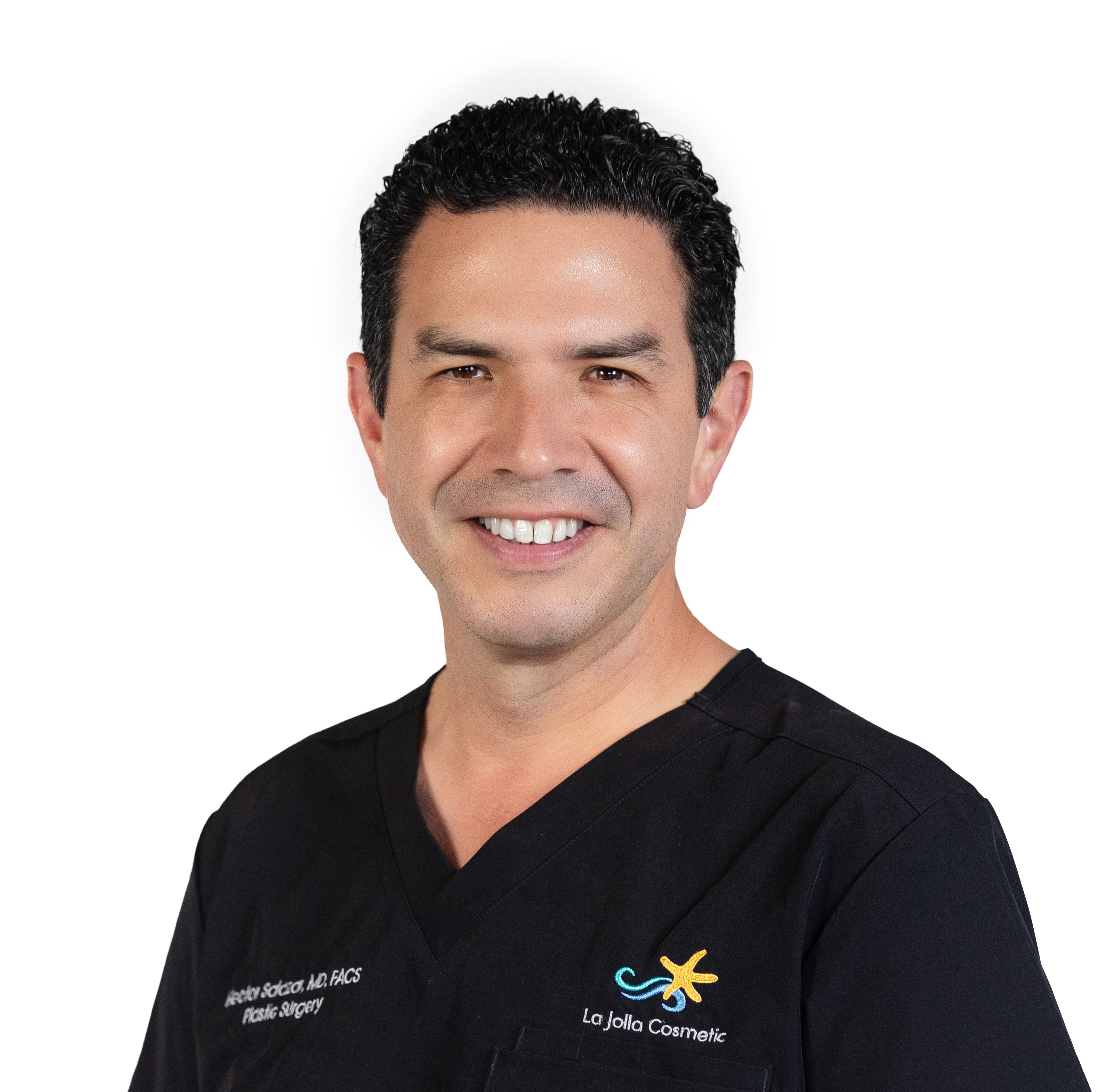
Plastic Surgeon
Having dedicated 17 years of his life to achieve the best medical training, Dr. Salazar’s philosophy is centered around providing beautiful results safely and ensuring each and every patient feels well cared for from their first appointment to their last.
In addition to being an American Board Certified Plastic Surgeon, Dr. Salazar is a member of the American Society for Aesthetic Plastic Surgery (ASAPS), a prestigious organization that is highly selective with its membership. Only plastic surgeons who demonstrate a high level of skill, experience, and expertise in aesthetic plastic surgery and cosmetic medicine are inducted into ASAPS.
Dr. Salazar is also a Fellow of the American College of Surgeons, an active member American Society of Plastic Surgeons, American Board of Plastic Surgery Maintenance of Certification Program, California Society of Plastic Surgeons, San Diego Plastic Surgery Society and the American Medical Association.