

Filler is an easy first step — quick, pretty much reversible, affordable. But there’s a moment patients know well: you’ve been filling the same area for years, and something still isn’t quite right.
Dr. Kiersten Riedler, facial plastic surgeon at La Jolla Cosmetic Surgery Centre who operates and injects, walks us through the three most common filler-versus-surgery conversations she has in the consult room — chin implants, rhinoplasty revisions, and tear troughs, where filler and fat transfer each tell a very different story.
Find out why a weak chin can make an entire nose read wrong, when liquid rhinoplasty can actually last for years, and why so many patients show up thinking they need another eyelid lift when what they’re really seeing is a bluish shadow from filler placed a decade earlier.
Links
Meet San Diego plastic surgeon Dr. Kiersten Riedler
Learn more about chin augmentation, rhinoplasty, eyelid surgery, and facial fat transfer
Questions answered in this episode:
- What can chin filler do well, and where does it hit its ceiling?
- How does a weak chin affect the way your nose looks?
- What does a chin implant procedure involve, and what are they made of?
- When does it make more sense to get an implant than keep doing filler?
- Do you need to dissolve chin filler before getting an implant?
- When is filler the right call after a rhinoplasty versus going back to surgery?
- How long does liquid rhinoplasty actually last?
- What can filler not fix on a nose?
- When is filler appropriate for tear troughs — and when is it not?
- What is the Tyndall effect and why does it show up years later?
- Does filler actually disappear over time, or does it stay longer than we think?
- When is fat transfer a better option than filler under the eyes?
- What's the one thing to know before your first filler appointment?
Learn from the talented plastic surgeons inside La Jolla Cosmetic Surgery Centre, the 12x winner of the San Diego’s Best Union-Tribune Readers Poll, global winner of the 2020 MyFaceMyBody Best Cosmetic/Plastic Surgery Practice, and the 2025 winner of Best Cosmetic Surgery Group in San Diego Magazine’s Best of San Diego Awards.
Join hostess Monique Ramsey as she takes you inside LJCSC, where dreams become real. Featuring the unique expertise of San Diego’s most loved plastic surgeons, this podcast covers the latest trends in aesthetic surgery, including breast augmentation, breast implant removal, tummy tuck, mommy makeover, labiaplasty, facelifts and rhinoplasty.
La Jolla Cosmetic Surgery Centre is located just off the I-5 San Diego Freeway at 9850 Genesee Ave, Suite 130 in the Ximed building on the Scripps Memorial Hospital campus.
To learn more, go to LJCSC.com or follow the team on Instagram @LJCSC
Watch the LJCSC Dream Team on YouTube @LaJollaCosmeticSurgeryCentre
The La Jolla Cosmetic Surgery Podcast is a production of The Axis: theaxis.io
Theme music: Busy People, SOOP
Announcer (00:00):
You're listening to The La Jolla Cosmetic Podcast with Monique Ramsey.
Monique Ramsey (00:05):
Filler is an easy first step. It's quick. It's pretty much reversible. It's affordable. But for a lot of patients where there comes a moment where you're just filling maybe the same area for years and then you're not totally happy, maybe something's not quite right. So the chin maybe is looking a little undefined or the nose bump that you don't love isn't quite as smooth as you want it to be, or the under eyes look hollow no matter what. So today we're going to go through three of the most common filler versus surgery conversations that happen inside a consultation room. And we're going to talk about chin implants versus filler, rhinoplasty revision versus filler, and tear troughs where filler and fat transfer each have a very different story to tell. And Dr. Kirsten Riedler is back to help us figure out when to stay in the injector chair and when to schedule to lie down in the OR. So welcome back to the podcast, Dr. Riedler.
Dr. Riedler (01:09):
Thank you for having me.
Monique Ramsey (01:11):
So let's start with the chin. What are patients usually trying to fix when they come in asking about filler? What's their underlying concern?
Dr. Riedler (01:21):
Well, for the chin, it typically is related to facial balancing and maybe the chin doesn't fit like the cheekbones or the nose looks large or they have kind of laxity here that's partially related to a retruded chin. So it tends to be not just about I want a bigger chin, but I want my face to look more balanced.
Monique Ramsey (01:49):
And then what can filler actually do well for the chin? And then where does it sort of start to hit the ceiling of effectiveness?
Dr. Riedler (01:59):
So filler is great for subtle augmentation. You can improve projection. You can smooth out a little dimpling. You can lengthen the chin a little bit, create a little bit of definition between the gel area and the chin. If I'm talking about using multiple syringes of filler and there's a significant deficiency, then I usually recommend an implant because there's definitely a limit to how far you can get with filler.
Monique Ramsey (02:33):
Now, you mentioned in a previous episode that a weak chin can sort of change how the entire nose reads on the face. And is that why sometimes you might bring up in a nose consultation about a chin?
Dr. Riedler (02:50):
Yeah, definitely. I mean, again, it kind of has to do with facial balancing. So if you have a relatively large nose and a small chin, just augmenting the chin helps the balance and kind of makes your nose fit your face a little bit better because your chin projection is improved. So generally, I wouldn't necessarily say to a patient who comes in and dislikes their nose that we can fix it with the chin implant or chin filler, but it can definitely improve the overall balance and the profile for sure.
Monique Ramsey (03:23):
Yeah. I would think that for some patients, their nose might be the main concern, but they've never really thought about their chin. Yeah, that's fine. And so that it's like sometimes the two together are a really nice way to harmonize. So if someone decides that they want a chin implant, what does that procedure actually involve?
Dr. Riedler (03:44):
So that involves a small incision. I usually do it right under the chin right here. Some people do it inside the mouth and it involves making a small pocket and placing the implant. There are a variety of different implant shapes and sizes. And so what I do is I use sizers during surgery to kind of see or practice seeing what it's going to look like with this size and shape before opening the actual implant. And that gives me a good idea.
Monique Ramsey (04:16):
Yeah. Whether it's like small, medium, large.
Dr. Riedler (04:18):
Yes. Small, medium, large, extra large.
Monique Ramsey (04:20):
Ah, okay. And so what are they made out of? Are they hard? Are they squishy? What is a chin implant like?
Dr. Riedler (04:28):
Kind of in between. So they're silastic, which is a polymer. So it's sort of like hard silicone essentially. Firm, but a little bit mobile.
Monique Ramsey (04:40):
Does it ever shift around once it's in there?
Dr. Riedler (04:44):
It shouldn't. If you secure it well and if there's no trauma during the healing process, then it should stay in place. And usually after a few months or so, patients really don't notice it. It just kind of feels like it's part of your face.
Monique Ramsey (05:03):
Oh, if I'm hearing right, you could have some filler, but that's going to go away eventually. And then the surgery ... So you might be paying, I don't know, a thousand dollars every time you have some more versus the cost of the chin implant and being done forever, right? It's permanent.
Dr. Riedler (05:21):
Yeah. Yeah. Generally, I would say for people who want to change the shape of the chin in a certain very specific, subtle way, I think filler can be better. And also for people who really have just a really minor deficiency of the chin, don't really need a whole implant, maybe just like one syringe of filler and that lasts a pretty long while. Then I think filler is a better option. But if it's really pretty significant, like we need a centimeter or so of increased projection or even half a centimeter, then I think the implant's the better way to go.
Monique Ramsey (06:01):
Yeah. Now, let's say somebody's been using filler in their chin for years. Does that stretch the skin out or does any of that become a problem if they choose to say, "You know what? I'm done with the filler. I just want an implant." And do you have to dissolve what's in there? Is the skin lax from the filler at all?
Dr. Riedler (06:23):
I mean, yeah, it can be lats, but I would always dissolve the filler before putting an implant in because I don't want the implant to change. I want it to be on a stable base and I don't want anything to move or change after the implant's in. I just want to start from scratch essentially.
Monique Ramsey (06:45):
So now let's jump over. So if anybody's been paying attention, we have a whole series called Read their Nose Noses. She knows them all the time. And so we have a series. And so we talked about on one of those episodes about liquid rhinoplasty and that being a real option for some patients. So we'll put that in the show notes so you can get up to speed on that if you haven't heard it. But when is it actually the right call if the patient's already, let's say they had their rhinoplasty and there's something that's just not quite to their liking and they might be tweaking it with filler as to, maybe there's a little bump and they want to make that little bump sort of camouflaged or when is it better to go right back to the OR for a revision. So what are your thoughts about that? And do you ever have that as something that a patient would come to you and ask?
Dr. Riedler (07:46):
Yeah. I mean, it's a really good question because they both can be options and sometimes I'll recommend filler, sometimes I'll recommend surgery. Sometimes I'll kind of leave it up to the patient and say either of these are reasonable options, but it's very specific to the patient and what their specific concerns and issues are. If it's a pretty minor thing, then filler can do a lot and it lasts pretty long and it's a great option. Whereas if you want a smaller nose or there are breathing issues or there are like significant kind of deformities or crookedness, there's definitely limitations to filler. It definitely cannot fix everything.
Monique Ramsey (08:32):
Right. Well, and especially if a patient's coming to you from another practice, let's say they had a rhinoplasty elsewhere, you might not even know what you're dealing with necessarily that's big-
Dr. Riedler (08:43):
That's kind of always the case. It's always a little bit of a mystery.
Monique Ramsey (08:47):
So like the conservative approach, if it's something that ... Like obviously if their nose is too wide, it's going to be hard to fix that with filler maybe, but if there's certain things that little tweaks ... Now, if you did some sort of liquid rhinoplasty for a patient, how long does that last?
Dr. Riedler (09:06):
I would say that the full result lasts for six to 12 months, but typically after touching it up maybe two or three times, it's going to last many years. So after maybe two to four treatments, patients really don't need a whole lot of maintenance. It lasts for a while in the nose.
Monique Ramsey (09:30):
Interesting. So you kind of build it up to what everybody's goal is. Is there ever a path where a revision rhinoplasty is really the best way forward for patients to be considering, how do I know which I need?
Dr. Riedler (09:46):
Yeah. Well, and one thing is like, I don't really expect patients to come in and know all the answers. That's why I'm here.
Monique Ramsey (09:53):
That's true. That's true. Yeah.
Dr. Riedler (09:56):
And that's what I love about doing surgical treatments and non-surgical treatments is that I can talk about and offer the whole-
Monique Ramsey (10:04):
Both.
Dr. Riedler (10:05):
Realm, all of the different options and talk about which one's going to be maybe best for their particular situation. But definitely if there's crookedness, if there are breathing problems, if the nose is too big, if there are significant irregularities, deformities, or any kind of breathing problems, surgery's going to be the way to go. If it's more subtle, minor asymmetries, a little bit of contour, irregularity, then filler's great.
Monique Ramsey (10:35):
All right. So our third topic today is looking at filler versus fat transfer under the eyes. So they call it tear troughs and that might be something that a lot of people ask about because if your eyes look tired or they notice the dark circles and it just has to do a lot with shadows, I think. So do you do both fat and filler there and when is it appropriate for which use case, I guess, for patients?
Dr. Riedler (11:12):
Yeah. So tear troughs and lower eyelids are complicated. There are a variety of things about the lower eyelid area that bother people from just hollowing to dark circles, to bags, to puffiness, to wrinkles. So step one is evaluating their anatomy and assessing what is the problem that we're trying to address. In younger people with good skin quality and really minimal to mild hollowing in this tear trough area right here, or even sometimes like over in the cheek area, the infraorbital holoween area, filler can be a really great option. It does require a lot of precision and restraint, I would guess, I would say, because you do not want to overfill this area and it has to be very precise and you want to underfill if anything. Overfilling in this area or even just placing it in the wrong location can cause puffiness, bags, a bluish hue, and I see this a lot.
Monique Ramsey (12:24):
I had that happen to me years after. I mean, like almost 10 years after having filler under my eyes and then all of a sudden it's that ... What do you call that effect?
Dr. Riedler (12:37):
Tyndall effect.
Monique Ramsey (12:38):
A Tyndall effect. Yeah. And I was like, "What is happening with my eyes?" And then one of the injectors in the med spa was like, "Oh, that's your filler." I'm like, "No, that was like in 2009."
Dr. Riedler (12:49):
I had that conversation multiple times a week with patients.
Monique Ramsey (12:52):
Do you really? That's crazy. Yeah. It's like all of a sudden it's like greenish blue. It's weird. So what is that coming from?
Dr. Riedler (13:00):
The filler, it lasts a long time there. And when it's superficial, because the lower eyelid skin is so thin and there isn't any fat in between the muscle and the skin in the lower eyelid. And so there aren't a lot of layers between the filler and the skin. And so you can kind of see this reflection or this bluish hue from the gel filler that kind of shows through and looks puffy, but-
Monique Ramsey (13:29):
So weird.
Dr. Riedler (13:30):
It's really interesting how it shows up 10 years later and rightfully so patients think that there's no way there could still be filler there, but-
Monique Ramsey (13:39):
Yeah. It took for mine to get dissolved. It took two full times and I've not done anything since. I'm like, no, I'm not doing that again.
Dr. Riedler (13:46):
Yes, that is a common situation.
Monique Ramsey (13:49):
So now do you ever do fat, like say you're doing an eyelid lift or some facial rejuvenation in surgery, your facelift or deep plane facelift, are you dealing with fat in that lower eyelid and are you ever injecting fat there or are you taking fat out or both?
Dr. Riedler (14:08):
Both.
Monique Ramsey (14:09):
Okay.
Dr. Riedler (14:10):
Yeah. So that's why there are kind of a range of options depending on what the issue is. So for again, young patients with like good skin quality, minimal holoween, those patients can do well with a little bit of filler. Those patients can also do well with a little bit of fat transfer to that area. Whereas if somebody has really significant hollowing or bags or excess skin, then I would usually recommend a lower blepharoplasty. And at the same time, when I remove some of the bulging fat and remove a little bit of the skin, I will almost always do a little bit of fat transfer also because that tear trough still tends to have some hollowing and even like along the cheek over here. So I often combine fat transfer with a lower blepharoplasty and with other procedures.
Monique Ramsey (15:07):
So when you take the fat to do the fat transfer, where are you usually taking it from?
Dr. Riedler (15:14):
If I'm taking it from the body, I typically take it from the abdomen or the inner thighs. Sometimes with a facelift, if somebody has a lot of buccal fat, buccal fat can be a really good fat to transfer also.
Monique Ramsey (15:24):
Which is that little pooch by off the side of your mouth. So that Tyndall effect comes up a lot, which is surprising to me because I kind of just figured, I don't know why I thought I was the only one who has this, where it's all about me. But so you're getting that question multiple times a week. That's so interesting.
Dr. Riedler (15:47):
Or not even necessarily the question about the Tyndall effect, but I will see patients who have puffy lower eyelids and think it's like fat, or they're maybe not sure what it is.
Monique Ramsey (16:03):
I thought I was just that it's been 20 years since I had my lower bleph done and that I needed another one. That's kind of where I didn't think it was going to be filler when she said that.
Dr. Riedler (16:14):
Yeah. But I think that's what a lot of patients come in thinking is that they need surgery and I'll look at it and say, "Did you ever have any filler there?" It was so long ago though. It was 10 years ago there's not any filler there and, hmmm, there probably is.
Monique Ramsey (16:30):
Well, don't you think that it's so interesting because we've heard over the years, this last a year, this the last 18 months, like different fillers have different lifespans. So we can sort of assume that 100% of it's gone at some point. And is that kind of a urban legend or something that it's all going to dissipate?
Dr. Riedler (16:52):
Yeah. So there have been MRI studies that showed, I think they showed that in every single patient who had had hyaluronic acid filler, it was still present 10 plus years later to some degree, not all of it, but to some degree. And what happens is that the clinical trials with the HA fillers, they are looking at patient satisfaction and like the effect of the filler for a certain amount of time. So when it's FDA approved or on label for 12 months or 24 months, that means that basically the vast majority of patients were still happy with the effect and they still had good results at that point. It doesn't mean that all the filler was gone at that point.
Monique Ramsey (17:40):
Oh, well- That's interesting. I didn't know that. Well, that makes sense then too, because at some point you're going to think, well, just in the logical brain too, you're like, "Okay, well, it must be gone by now. It's time for more. It's time for more." So across all three of these use cases, let's say chin, nose, tear troughs, what's the one thing that you wish patients understood before they start filling or before they even have a consultation?
Dr. Riedler (18:09):
I think the main thing is just to be open-minded and consider all of your options. Some people don't want failure, some people don't want surgery, that's fine, but I think at least having some open-mindedness and knowing what the options are can be helpful and working with a surgeon or injector you trust to kind of review a treatment plan and review what your options are before moving forward so that you can achieve your goals.
Monique Ramsey (18:39):
Yeah. Yeah. Well, and I think having somebody like you where you spend a day a week in the med spa, you're in surgery, there are other days you're in consultation with patients. And so for you, you're happy to serve the right outcome for that patient and you have skin in the game either way. So I think just having that conversation, like you say, and having an open mind I think is so true. We tend to come up with sometimes some conclusions on our own and then that becomes the new thing "What are these nine other things? Oh, I could have ... " I don't know, you just don't necessarily, once you have something fixed on your brain, then it's hard to think about other options. So I like that idea. So what we're going to do today is we'll put in the show notes some of the other episodes that we've done, because I think we did a full episode on fat versus filler, just not specific to tear troughs or specific to noses. And so we'll put that in the show notes. And for everybody out there, if you're listening today, if you have questions, we'll have links on how to set up a consultation. There's no charge to have your consultation with Dr. Riedler. If you think you want to explore the possibilities, we invite you to do that. And thanks for listening and for everybody out there, subscribe. Every Tuesday we have a new episode and going on almost five years now. So there's a lot of good content out there and we'll keep bringing you more. So thanks everybody.
Dr. Riedler (20:16):
Thank you.
Monique Ramsey (20:17):
Thanks, Dr. Riedler. Bye-bye.
Announcer (20:23):
Take a screenshot of this podcast episode with your phone and show it at your consultation or appointment or mention the promo code PODCAST to receive $25 off any service or product of $50 or more at La Jolla Cosmetic. La Jolla Cosmetic is located just off the I- 5 San Diego Freeway in the Ximed Building on the Scripps Memorial Hospital campus. To learn more, go to ljcsc.com or follow the team on Instagram @LJCSC. The La Jolla Cosmetic Podcast is a production of The Axis, T-H-E-A-X-I-S.io.
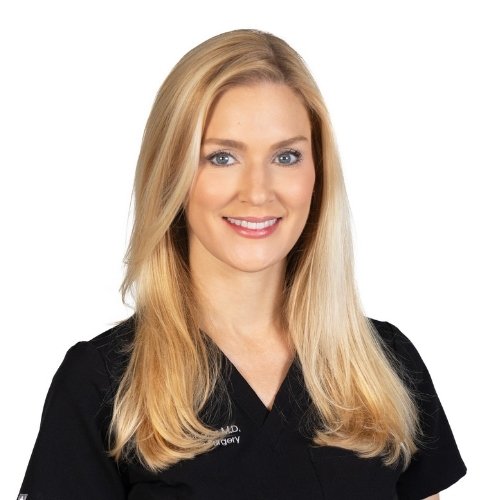
Plastic Surgeon
Dr. Kiersten Riedler was born and raised in San Diego and graduated from Harvard University with honors in neurobiology and a foreign language citation in Spanish. She earned her medical degree from the University of Southern California Keck School of Medicine, where she also completed a 5-year residency program in otolaryngology – head and neck surgery. At USC, much of her training took place at LAC+USC Medical Center, also known as LA County Hospital, where she predominantly cared for underserved, Spanish-speaking patients.
Dr. Riedler is fluent in written and spoken Spanish and became a certified medical interpreter at LAC+USC Medical Center. After residency, she completed a one-year fellowship in facial plastic and reconstructive surgery in Beverly Hills.