




Nearly 40 years, thousands of patients, and a career that started unexpectedly in a National Guard medical unit—Dr. John Smoot’s story is full of the wisdom, wins, and lessons you only get from a lifetime in plastic surgery.
Dr. Smoot looks back on how the field has transformed since he first scrubbed in, from evolving techniques to the rise of natural, proportionate results and the growing acceptance of cosmetic procedures. He shares what’s surprised him, what’s stayed the same, and what he believes is coming next as less invasive treatments continue to take over.
Hear why he’s always chased improvement, how he balances artistry with science, and the traits that he believes every great surgeon has to develop.
Plus, he opens up about mentorship, the relationships that shaped his career, and the legacy he hopes to leave as he heads toward retirement.
Links
Meet San Diego plastic surgeon Dr. John Smoot
Book a consultation with Dr. Smoot before he leaves
Learn from the talented plastic surgeons inside La Jolla Cosmetic Surgery Centre, the 12x winner of the San Diego’s Best Union-Tribune Readers Poll, global winner of the 2020 MyFaceMyBody Best Cosmetic/Plastic Surgery Practice, and the 2025 winner of Best Cosmetic Surgery Group in San Diego Magazine’s Best of San Diego Awards.
Join hostess Monique Ramsey as she takes you inside LJCSC, where dreams become real. Featuring the unique expertise of San Diego’s most loved plastic surgeons, this podcast covers the latest trends in aesthetic surgery, including breast augmentation, breast implant removal, tummy tuck, mommy makeover, labiaplasty, facelifts and rhinoplasty.
La Jolla Cosmetic Surgery Centre is located just off the I-5 San Diego Freeway at 9850 Genesee Ave, Suite 130 in the Ximed building on the Scripps Memorial Hospital campus.
To learn more, go to LJCSC.com or follow the team on Instagram @LJCSC
Watch the LJCSC Dream Team on YouTube @LaJollaCosmeticSurgeryCentre
The La Jolla Cosmetic Surgery Podcast is a production of The Axis: theaxis.io
Theme music: Busy People, SOOP
Announcer (00:00):
You're listening to The La Jolla Cosmetic Podcast with Monique Ramsey.
Monique Ramsey (00:05):
What does it feel like to close the chapter on a 35 plus year career that's transformed thousands of lives here in San Diego and maybe even farther reaching as he approaches his retirement? As one of San Diego's most trusted and respected plastic surgeons, Dr. John Smoot joins us today to talk about his journey in plastic surgery. Welcome back Dr. Smoot.
Dr. Smoot (00:30):
Thank you, Monique. Glad to be here again.
Monique Ramsey (00:33):
Good to have you. So I know it's not like imminent, like you're going to retire tomorrow, but you are retiring soon. So we're shooting for maybe in the spring. So as we prepare for that, I was kind of thinking it'd be good to talk to you about your last three decades in this specialty and how it feels to be at this stage of your career.
Dr. Smoot (00:58):
Well, you don't think it's ever going to arrive, but it's been almost 40 years that I've been involved in plastic surgery, and it's been a wonderful journey. The funny thing is I still feel like I'm the young kid in the block. There's still some guys older than me that are still out practicing, but still, it just went by so fast.
Monique Ramsey (01:20):
Well, isn't that the way life is? All of a sudden it's Christmas and then all of a sudden it's five years from now and your kids are grown and then you're retiring. And so when you look back at your journey from Salt Lake City to La Jolla, what stands out the most?
Dr. Smoot (01:37):
What stands out the most to me is the incredible journey. It is with patients, with colleagues, people I work with that it's just been a wonderful process and it's been a neat opportunity to serve others and to associate with others and while doing good to others, and I really have enjoyed that aspect of it. And leaving Salt Lake, I thought when I left Salt Lake City to do my internship and residency, I was going to return, but that just didn't happen. Other plans happened faster and other things. I joined my brother when I came down here, which was the best thing that ever happened to me was to do that.
Monique Ramsey (02:16):
Yeah. And you two practiced together for how long?
Dr. Smoot (02:21):
Probably 20 years.
Monique Ramsey (02:22):
Wow. Yeah. Wow. So tell me, I know you were in the National Guard and how did that influence your discipline or your approach to surgery?
Dr. Smoot (02:31):
Let's go back a little farther. When I was in high school, my older brother had already gone into medicine and was being a general surgeon. Then he wanted to be a plaster surgeon, but I kind of always thought I liked sciences and I thought I'd always want to be a physician. So I got pretty focused on that goal and becoming a physician, and that's really what I was headed for, but it wasn't when I was during the Vietnam war time, the draft was going strong and I got a draft number of 14, so I was going to get drafted and do something. So I decided I better join the National Guard. So I joined the medical unit called the hundred 44th Evac Hospital, and that's where I kind of got a taste of medicine and I said, this is what I like. And I said what I want to do. So when I got back into school, I said, I want to go to medical school, and that's where I ended up.
Monique Ramsey (03:21):
And tell us about your medical school training after you came back from the medical part of the military.
Dr. Smoot (03:30):
I was in the military for about 10 years. That was my obligation to do that. But so doing though I was in medical school during that time period too, so I was going to the guard and going to the medical school.
Monique Ramsey (03:44):
So you've said you wanted your life's work to serve others, and do you feel that this career choice has helped you accomplish that?
Dr. Smoot (03:57):
Oh, absolutely. Initially, in my early years, I did a lot of reconstruction, a lot of trauma work. I used to do a lot with kids and cleft palates and things like that, and that was really rewarding to put people back together again to help them navigate through life. It was sad in one way. You saw all the disasters that happened, but again, trying to take someone who's abnormal and make them feel normal, whereas in cosmetics or just taking somebody who's normal and making them make 'em look better, it's a little different genre there.
Monique Ramsey (04:28):
True, true. But I guess at the end of the day, you've got that feeling of you've helped them achieve a goal and that patient on the inside is feeling happy and better about him or herself, and you were a part of that. So that must feel really rewarding and fulfilling.
Dr. Smoot (04:49):
It was. And other people do things that are different and serve in other ways, but this was what I felt I could serve. People did things and accomplished things that I could never do. But then again, I'm doing things that most people couldn't do either. So it was kind of a good feeling to know that I was helping humanity in one way and serving my fellow, being in a way it was pleasing to me and them, I think.
Monique Ramsey (05:16):
Yeah. So you said almost four decades. So in this time I'm sure things have changed. And what do you think's really changed the most in plastic surgery since you started practicing?
Dr. Smoot (05:32):
That's a good one. A lot of it hasn't changed, but I think there's been more refinement, more quality in the things that we do, more scientific basis and what we did. There's a lot of what we call current plastic surgery today is nothing like what they did in World War ii. That's really when it really got started. And I trained with one of those doctors, Dr. Cron and Dr. Brower that did a lot of those surgeries on the servicemen where they learned how to do flaps and reconstruct things. That's where it all started, and it was just fascinating to see how you could do those things. And so that was a real pull for me. Then as I moved into more of the cosmetic arena, the story was when I was a resident, one of the plastic surgeons says, I don't do anything like I did when I was in my residency. I was thinking, well, didn't you learn anything? What's wrong with you? And now they look back. I said, absolutely. I don't do much of what I did in my residency now because it's progressed, we've learned, we've improved our techniques, we've found better ways to do things.
Monique Ramsey (06:35):
So what are some lessons that took maybe years for you to learn? Things that younger surgeons might not yet appreciate?
Dr. Smoot (06:43):
I can't say there's one thing, but generally it's learning confidence. I know when I first started doing facelifts, that was scary and intimidating and now it's not at all. I've learned, have the confidence in my doing and learning the techniques. But it's something in that arena. You always have to be learning. There's always somebody who has a better mousetrap. There always someone who has a better technique. And I've always liked going to my colleagues and in the meetings and saying, okay, what are you doing? How are you doing it? I always wanted to improve what I was doing. It was never like, okay, I'm just satisfied what it is. No, I wanted to learn new ways doing it, and I realized I wasn't the smartest kid on the block. I wasn't the smartest doctor, but I could certainly learn from those who are, and that was my goal, is to always be improving. Even today, I still look at the meetings. I look at people that I listen to and respect and say, okay, how do you take this problem? What do you do to this problem now? I like to know how you solve that.
Monique Ramsey (07:43):
Yeah, it's sort of this 3D puzzle that you get to do in the OR every time you have a new patient. Right. I would think it could be very complex, and I'm sure no two people are alike. No two breasts are alike, even on the same person. So that makes sense.
Dr. Smoot (07:59):
Exactly right.
Monique Ramsey (08:00):
So what is one piece of advice that maybe you wish somebody had given you at the start of your career?
Dr. Smoot (08:07):
If I had to say one piece of advice was to be patient and continue to be humble and willing to learn. Those are the things I think made the biggest difference in my life. So I would say learn how to be good, then learn to be fast.
Monique Ramsey (08:27):
Efficient. Efficient is good. Over the years, you've got artistry with plastic surgery and you've got the science. And how do you kind of learn to balance the two components?
Dr. Smoot (08:41):
Well, that just comes with experience. You've got to have a feel for it. Now, there's some doctors, plastic surgeons just never get it. They just don't see how aesthetic artistry come together. And you have to understand the anatomy. You have to understand what you can and can't do because anything you do in his business is not static. It moves, it changes, it evolves. And so you have to anticipate that. And that's the thing you've got to understand, is it not going to be the same every time, every result's not going to be the same.
Monique Ramsey (09:14):
Now you're known for your advanced breast lift and scar reduction techniques and secondary augmentations. Maybe people who have had a capsule and they come back and ask you, maybe they started with you and their body sort of took over and went one direction, or they saw a different surgeon to start with and they come to you for help. And what really inspired you to focus on that area?
Dr. Smoot (09:40):
Well, early on, because I trained with Dr. Cronin, the new doctor Drew, they were the first doctors to put implants in women back in Houston. So I trained with them and I got to see some of those very early results. I got to see all the problems that came with it. And then I went with my brother who was 10 years older than me, and we kept seeing these recurring problems in the breast that is capsular contracture. And it was just, well, once you got it, it was a difficult problem to deal with and didn't have much choices. It wasn't until I went to a lecture and heard Dr. Pat Maxwell and Alan Gabriel talk about this new technique about using graphs. It was a real problem. How do you deal with these capsular contractors? And that's when I learned how to do this. That made all the difference in the world. But taking these women who had basically breast cripples in a way that these awful looking breasts and what are you going to do to fix it? We didn't have much. That changed the whole outlook of how I approach surgery. And that made a big difference in these women. So I got to use with all their patients, I was able to learn how to use these techniques. I wasn't the first one to start doing it, but I learned very early on how well it worked. And that's why I like to use those techniques.
Monique Ramsey (10:57):
And you're talking about the grafts. Explain to the audience if they haven't heard about what this is, what they are and how they function.
Dr. Smoot (11:04):
Well, when I talk about graft, we're talking about ADMs, a dermal cellular matrices. Basically it's a collagen matrix of tissue. It comes in several different forms. The most common ones are the pig skin. One, it's made out of pig skin, but it's a collagen matrix. There's a human form called AlloDerm. There's some other things out of peritoneum from pigs and some other things are out. There's lots of things out there. But I found that the one that I use is called STRATTICE, is the pig skin. One worked very well, and you just lay it inside the breast. They don't know it's there, they can't feel it. And it does a very good job of keeping the breast soft, particularly if they've had problems with capsular hardening and they want to do something because the risk of having a recurrent capsule was 10 to 20%. You put a grafting, it goes down to one or 2%, which is really significant, particularly for women that say, can I ever have nice looking breasts again? Yeah, we can.
Monique Ramsey (11:59):
So how has your research shaped how you operate?
Dr. Smoot (12:04):
Well, that changed everything how I operate, particularly on the breast. Rarely do you say anything in plastic surgery is better than sliced bread, but these grafts were better than sliced bread. They really worked. It made a big difference in the outcomes and having to help these women feel and look better.
Monique Ramsey (12:22):
In your eyes, what separates a good plastic surgeon from a great one?
Dr. Smoot (12:27):
A desire to learn and not being saying that I'm the best I know everything. Realizing your limitations, what you do and what you don't know. And the old saying is they don't know what they don't know. And there's really some truth in that. If you take the time to learn and listen from these other doctors, other people have experiences, you can incorporate those things. I can think of a lot of the procedures I do as part of that's from that doctor. Part of this is from that doctor, and I learned that from him or that from her. All those things add up to what I do now.
Monique Ramsey (12:59):
Now is there a particular surgery that you do that still excites you every time you perform it?
Dr. Smoot (13:06):
Yeah, I still like to do augmentations. I still like to correct the disfigured breasts. I still like that, and I still like doing facelifts.
Monique Ramsey (13:15):
Well, that's good. I think doing what you love is always going to feel the best. You're probably the best at it when you are doing something you're passionate about and that you're good at. And so that's nice. I think at the end of a career, it would be easy for some people to sort of check out and not feel like, eh, whatever. I've done this for 40 years and I'm over it. I get the sense that that's not, you.
Dr. Smoot (13:46):
You got that right.
Monique Ramsey (13:49):
So you've always emphasized proportion and balance over dramatic change. And I think some doctors are all about these dramatic results or we see that on social media and it's like, I don't know if I want that. And you've always been very particular about natural. And how did that philosophy develop?
Dr. Smoot (14:12):
Well, it just came over time. My motto is, and what my agenda to work under is, I want something to look like it's real. It's natural is proportionate. Some say, well, what size implant should I have? Well, it's based on your height, your width, the width of the breast, how much tissue you have. All those things come in. There are doctors say, yeah, I just want to put big implants. I like big boobs. Okay, well that's fine. I want someone to look proportionate. And I always tell the girls, I said, look, if someone comes up to you and say, are those real? Did it right.
Monique Ramsey (14:48):
Yeah. It's the change that just feels like you at the end of the day, that that's part of you. I think that's the most important thing that a patient could want is something that feels like part of them, not like something different got stuck on not Mr. Potato Head.
Dr. Smoot (15:08):
That's right.
Monique Ramsey (15:11):
Now, is there a story of a patient transformation that still moves you today or sticks with you?
Dr. Smoot (15:17):
I guess there's one that I really think about often. It was a trauma patient that had an accident. He injured his face badly, and basically the skin of his face was removed, but that was it. And we ever heard the Terminator movie when Arnold Schwarzenegger comes out and all you can see is the eye. That's what he looked like.
Monique Ramsey (15:36):
Wow.
Dr. Smoot (15:37):
And we had to reconstruct him, put him back together again, facial bones, eyes, eyelids, everything. And it turned out pretty good. And that was really kind of a nice thing. And he came back years later and showed me what he looked like. And he wasn't perfect, but he was presentable. I mean, those are the kind of things that I look back and say, God really helped that guy. Glad I could do that.
Monique Ramsey (15:57):
What legacy do you hope your patients remember you by?
Dr. Smoot (16:02):
That I was honest and I spoke the truth. I didn't try to aggrandize myself. I didn't try to upsell them because that happens all too often. You came and have your facelift, we can do your eyes too, or we can do some liposuction. I didn't do that, honest. I thought it was very necessary in terms of how the result was going to be. So I tried to address what their concerns were and not try to upsell or change it just so I could do more in my business sense like, oh, I'm going to do this. I can, I'd never do that. If I felt like I couldn't improve on something, I'd tell 'em. I say, this is not because it's beneficial to me. It's beneficial to you.
Monique Ramsey (16:44):
What qualities do you hope that the next generation of plastic surgeons will carry forward?
Dr. Smoot (16:51):
I hope that they will carry forward that of being sensitive, being knowledgeable, and treating people with the respect that they want to be treated like. I think that's the best thing we can do for our society and for our future, and becoming well-educated in what we do and not thinking you've got all the answers. The first thing I learned very quickly, I don't have all the answers. And if there were other people that do the answer better than me, I wouldn't hesitate to ask them or send them to them.
Monique Ramsey (17:24):
I think it must be nice in that spirit of learning that you've embraced to be in a group practice. I mean, you are with your brother for 20 years, then now you're with five other surgeons, and to be able to have that way to share techniques or bounce ideas off, have you felt that?
Dr. Smoot (17:47):
Oh, absolutely. I've never been in a solo practice. I've always been in a group practice. And always, when I first came out, I was with some very senior surgeons. And when I came out of my residency, I came in, the first year I spent with them was going through an internship again, and I was mentored by them. And I learned very quickly how to pick up different things from them and learn from them.
Monique Ramsey (18:10):
Does that learning take place in the OR where you're watching those surgeons, the senior, when you started your career in residency watching? Or are they watching you or a little bit of both?
Dr. Smoot (18:22):
Little bit of both, but mostly it's when it's a different feeling when you're in your residency and the attending sitting across from you and you're, oh yeah, I can do this. I do that. And when you get out in the public and you're doing on your own, it's like he's not across the table anymore. I can't ask him how to do this. I've got to decide how to do it and make my plan. And that took some time to build that confidence. And it comes with time and being humble and learning to learn from others. And that's always the best way to go forward, I think.
Monique Ramsey (18:53):
Yeah, I'm thinking if I was addressing some envelopes for a save the date the other day and trying to make them look really beautiful, and if it started to mess up, I ripped up the envelope and I could start again. And in surgery there is no ripping up the envelope. And let me start back at the beginning. And I think that must be a little bit terrifying, especially when you're starting out.
Dr. Smoot (19:18):
But the thing is, in surgery, you've got to learn how to be able to adapt. You go in with Plan A uhoh, this isn't going to work. Got to have plan B, uhoh, I got to have plan C. And you learn, how do I put it this way? Be a MacGyver, figure out things as you go. And I remember doing a lot of cases and that didn't work out, and how can I improve that? And you think of different ways to do things, so get the outcome you want.
Monique Ramsey (19:47):
In your, OR, this is not in my list of questions, but I'm just curious as you're MacGyvering there, are you listening to music or no music? And if you listen to music, what do you like?
Dr. Smoot (19:58):
Well, I do like music. I like very sedate, quiet music. As I tell the staff, I want to feel relaxed. I don't want to feel pressure. I don't want to be annoyed by surrounding ambient things going on. Some doctors don't like music, but again, I do. But it's a very low key.
Monique Ramsey (20:16):
Yeah, I think, and it's so nice. You can go on Spotify or in Apple Music or wherever you get your music, and I'll look for music to concentrate if I'm really trying to focus on something or music to study by or to be creative. And it's amazing how many different crazy playlists are out there. And some I like and some I don't. But I'm with you on that where it's like, I like that sound, but I don't want it to be so distracting that I can't focus. So what excites you the most about the future of plastic surgery, even as you close out your career?
Dr. Smoot (20:54):
Well, I think what excites me is that we're learning how to do more with less. This is why you see the rise of med spas, injections, all the non-invasive things going on. That just seems to be the big push right now that he's trying to not do as much surgery, but do more things to help them look good without having to go into the big surgical procedures. And I think that we're pretty much hitting a good balance with that. But again, there's always new stuff coming out, but the one thing I've learned, and I've found that you can't jump on every bandwagon that comes by. And I've learned that if it's good today, it should be good tomorrow. And if it's good tomorrow, it'll be good in three years, then I'll try it. I've been burned by, oh, that sounds really good. That's a new technique. Then you Oh, oh, shouldn't have done that. Let other people try it and make sure it works before you do it. I hope that helps.
Monique Ramsey (21:51):
Well, and I think part of having the med spa counterpart to the surgery center is that for a patient who comes to you and maybe says, here are the things that bother me. You're able to say, actually, you're not ready for surgery yet. Or maybe this and that and the other is good in a noninvasive from the med spa side, or vice versa. If they have a patient who thinks they need a little cool sculpting under their chin, but they really need a facelift, it's having that where not every solution is the solution that you have to push them towards. You can help them give them the tools to make that the correct decision. So in terms of what's been the most rewarding part of your daily routine? Just something that you'll miss and I have an idea of one of the things you might say.
Dr. Smoot (22:44):
You know what I'm going to miss. I'm just going to miss the people I work with. I've just been so blessed through my lifetime with having wonderful people to work with, good, strong, ethical, hardworking people. My nurse, Shelly, I couldn't do what I do without her. She's just a marvelous support, she's knowledgeable, happy, and as is all the people that work in this office, they're the people that I'm going to miss the most. I'm going to miss my patients, but I'm mostly going to miss those people I come to work with every day.
Monique Ramsey (23:19):
Yeah, I think that would be, I think you said the other day you think of Shelly as like your work wife.
Dr. Smoot (23:26):
That's exactly right.
Monique Ramsey (23:28):
And yeah, that's going to be
Dr. Smoot (23:29):
She's the only one in the office gets to call me Smooty.
Monique Ramsey (23:33):
She does say Snooty doesn't she?
Dr. Smoot (23:35):
She does.
Monique Ramsey (23:35):
That's very cute. We won't put that in the show title, I promise. Okay. So when you finally hang up your scrubs, how do you plan to spend your time?
Dr. Smoot (23:46):
That's a little bit of a problem because you think you've got all these things you want to do, but it's not very well scheduled. But we are going to do some things, spend more time with our kids and grandkids. I think we're going to be serving a mission for our church and where they send us, we don't know. It could be medical, it could be crosslighting, we don't know. We'll just do what they want us to do and that'll take us about a year, year and a half of that. I think that's probably as far as I can see in the future. I still have some hobbies I like to do. I'm an archer and I love to shoot my bow, and that's something I enjoy immensely. I don't golf, but I do fly fish. And we have a summer home in Idaho. I like to go to,
Monique Ramsey (24:23):
I think that's something you shared with Dr. Wheeler, right? Didn't Dr. Wheeler Fish? He was a fisherman.
Dr. Smoot (24:29):
Yeah, we did.
Monique Ramsey (24:29):
I remember doing his retirement postcard and there was a picture of him in the water fishing.
Dr. Smoot (24:35):
Love of the outdoors. We both have a fell love in.
Monique Ramsey (24:38):
Yeah. Well, I would think that when you are in Idaho in the summers, that's probably at your happy place.
Dr. Smoot (24:47):
It is. I've been going there for 60 years.
Monique Ramsey (24:50):
Oh wow.
Dr. Smoot (24:51):
Started going there longer than that. I was five years old, so it's probably 60, almost 70 years, 68 years I've been going up there.
Monique Ramsey (25:00):
Wow,
Dr. Smoot (25:02):
Love it.
Monique Ramsey (25:04):
That's neat. So if you could summarize your career in one word, what would it be?
Dr. Smoot (25:11):
I think it would be a desire to do good, putting it that way. One of the things, you haven't asked me this, but I'm going to transition a little bit into this. I used to talk to the medical students a lot and I said, medicine will take everything you'll give it, but you've got to balance your life out because you think of all the professors, people you've met along the way, how many are still married to the same people or with the same people they do. When they started, not very many, I said, medicine will chew you up and spit you out and become your identity. It can't be. Identity is to be that first. We're all the human race, we're all brothers and sisters. We need to serve each other. We need to take care of each other. And by focusing on the back that you want to be something other than a doctor that doesn't necessarily define you.
(26:03):
One of the things I always wanted to do when I walk away from people is when I leave them, I hope I left them feeling better than when I met them. I used to always tell the kids when I used to work with them just when they left for me, I'd always say something positive. So their leaving for me was a positive experience, and I kind of want the same feeling as I end up my career is. Yeah, he did his very best. He really cared. Did I do everything right? No. Did I make mistakes? Yes. Did. I wasn't perfect, but I really tried to do what was right.
Monique Ramsey (26:34):
Well, having a heart of gold helps, having magic hands helps. I'll give you those two things.
Dr. Smoot (26:40):
Well, it isn't magic, but I tried to do my best.
Monique Ramsey (26:43):
But everybody's best is different. And I think your best is at a really high level based on especially I've seen your results, but also your patients are like rabid fans. We sent out that little card saying that you were going to retire, and it was like the phone started ringing and
Dr. Smoot (27:05):
Sure did. It got busy real quick.
Monique Ramsey (27:07):
Got busy. Really. It was a good thing we plan that ahead, but well, thank you Dr. Smoot for joining us. It was really a pleasure to do this little pre pre-party before the party of you actually retiring and you getting to go do your fishing and your archery and your missions. And so we've loved having you at the center. I think we've been honored to have you at the center and it's wonderful working with you and thanks for joining us and sharing this information about your career.
Dr. Smoot (27:42):
Well, it's been a pleasure, Monique. And I say you've been an awesome and integral part of all the success we have here. So thank you to you and everyone else who's behind the scenes, what we don't ever get to see. So Hannah and everyone else puts this together. I've been blessed to have quality people who really love what they do.
Monique Ramsey (28:01):
Yeah. Thank you. Alright, everybody, well check our show notes if you have any questions, want to see gallery photos, want to set up a consultation with Dr. Smoot before he leaves. We will put that all in the show notes for you and we look forward to seeing you next time. Bye.
Announcer (28:24):
Take a screenshot of this podcast episode with your phone and show it at your consultation or appointment or mention the promo code PODCAST to receive $25 off any service or product of $50 or more at La Jolla Cosmetic. La Jolla Cosmetic is located just off the I-5 San Diego Freeway in the Ximed building on the Scripps Memorial Hospital campus. To learn more, go to ljcsc.com or follow the team on Instagram @ljcsc. The La Jolla Cosmetic Podcast is a production of The Axis, theaxis.io.
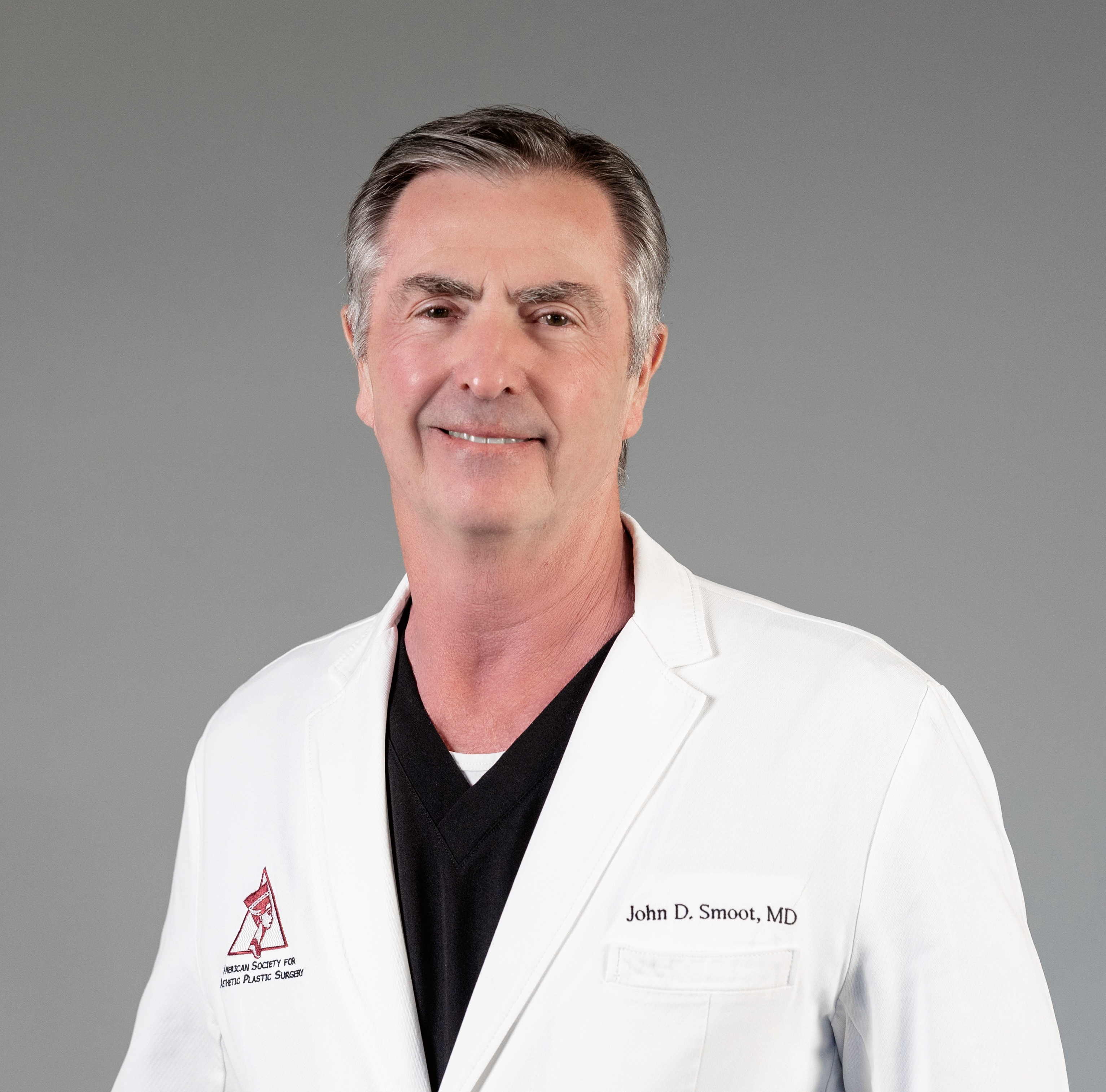
Plastic Surgeon
During his 30 years as a Board Certified Plastic Surgeon in San Diego, John D. Smoot, MD, FACS has earned a reputation for providing excellent care and beautiful cosmetic surgery results. Dr. Smoot is the Medical Director of La Jolla Cosmetic Surgery Centre & Medical Spa.
Dr. Smoot has an extraordinary depth of skill and experience in plastic surgery that make him highly sought after for breast, body, and facial surgery alike. He is well-known in La Jolla for his advanced scar-reducing techniques with breast lift surgery. In addition to breast augmentation, facial rejuvenation and body contouring surgery comprise a substantial portion of his practice.
Dr. Smoot has been board certified by the American Board of Plastic Surgery since 1990 and has served as Chief of Plastic Surgery at Scripps Memorial Hospital La Jolla, where he remains on staff. He is also an active member of the American Society of Plastic Surgeons, the American Society for Aesthetic Plastic Surgery, and the California Society of Plastic Surgeons.