




Surgery doesn’t end when the procedure is over—and that’s the part most people don’t hear enough about. San Diego plastic surgeon Dr. Hector Salazar explains why what happens after can be just as important as the surgery itself.
Follow-up visits are a critical part of healing safely and confidently, not just a formality. He walks through what to expect during recovery, why open communication with your surgeon matters, and which warning signs should never be brushed off.
Dr. Salazar shares how to choose the right surgeon, from board certification and hospital privileges to the years of training required to manage complications if they arise. He explains why not every provider offering cosmetic surgery has the same level of expertise and why safety should always come before cost.
From recovery houses and local support to the realities of medical tourism, Dr. Salazar emphasizes the importance of having a real safety net in place, because feeling supported shouldn’t stop once surgery is over.
Links
Plastic Surgery Practice, After Outpatient Cosmetic Surgery, They Wound Up in the Hospital or Alone at a Recovery House
Learn more about patient safety
Read more about San Diego plastic surgeon Dr. Hector Salazar-Reyes
Listen to our previous episode, What NOT To Do During Recovery After Plastic Surgery
Learn about the best hotels in San Diego if you’re considering traveling to see Dr. Salazar
Learn from the talented plastic surgeons inside La Jolla Cosmetic Surgery Centre, the 12x winner of the San Diego’s Best Union-Tribune Readers Poll, global winner of the 2020 MyFaceMyBody Best Cosmetic/Plastic Surgery Practice, and the 2025 winner of Best Cosmetic Surgery Group in San Diego Magazine’s Best of San Diego Awards.
Join hostess Monique Ramsey as she takes you inside LJCSC, where dreams become real. Featuring the unique expertise of San Diego’s most loved plastic surgeons, this podcast covers the latest trends in aesthetic surgery, including breast augmentation, breast implant removal, tummy tuck, mommy makeover, labiaplasty, facelifts and rhinoplasty.
La Jolla Cosmetic Surgery Centre is located just off the I-5 San Diego Freeway at 9850 Genesee Ave, Suite 130 in the Ximed building on the Scripps Memorial Hospital campus.
To learn more, go to LJCSC.com or follow the team on Instagram @LJCSC
Watch the LJCSC Dream Team on YouTube @LaJollaCosmeticSurgeryCentre
The La Jolla Cosmetic Surgery Podcast is a production of The Axis: theaxis.io
Theme music: Busy People, SOOP
Announcer (00:00):
You're listening to The La Jolla Cosmetic Podcast with Monique Ramsey.
Monique Ramsey (00:05):
A recent investigation details a patient being told she "absolutely should not go to the ER even after a gush of foul fluid came from her incision. In a review of malpractice cases, post-op care was blamed in over two thirds of them. Dr. Salazar, who's obsessed with patient safety and what happens after surgery is here to lay out the safety standards you should expect before you ever say yes. Welcome back to the podcast, Dr. Salazar.
Dr. Salazar (00:41):
Monique, how are you? It's a pleasure always to come and chat with you and with your audience, and we really are excited to talk about safety every time we get an invitation. Let's start talking about this cases that you wanted to share with me.
Monique Ramsey (00:57):
Yeah. So when you read stories where patients go to the ER or they're told not to go to the ER, they maybe want to go to the ER and they're not sure what to do, what's your gut reaction and what should patients do instead?
Dr. Salazar (01:11):
Well, it is unfortunate.That's what I would tell you. That's my first reaction. It is important that patients know exactly what to do on which circumstances. And for instance, as you know, when our patients come here to get ready to have surgery at La Jolla Cosmetic, they spend a full hour with a nurse going over how to nest for surgery and what to expect in those first days after surgery. Also, they're going to get exactly how to communicate with us and under which circumstances they should do what. So it's really, really important for a patient right immediately after surgery to remain in close communications with their surgeon and with the surgical team. There's nobody in the world that knows better what was done during surgery than the original surgeon and what to expect right after surgery. So sometimes patients, and we make that clear, they don't want to bother the surgeon or they don't want to bother the surgical team.
(02:20):
And we tell them, "No, that's exactly what phones are for. " I mean, that's going to be your first weapon. It's going to be a phone to text, to call, to establish that communication with the surgeon. And then immediately after that, the surgeon who knows exactly what are the signs, what are the symptoms, what are the red flags, will make a determination to ... And we're talking about outpatient surgery, that's what we're talking about, right, Monique?
(02:50):
In which patients have surgery and then they go home and then what happens right after that? So to touch base with the surgeon to see if a certain symptom is expected or not, is it a red flag? Is it something that should be actually not even be considered as something? Or is it something that either we need to start like a Zoom call or to start a face time call or to let's head to the office and let's see you, even if it's at three in the morning. Or if it's something that, you know what, let's not waste any time. Let's go to the ER depending on the circumstance. But the person, the ideal person would be the surgeon. And for that, they need to stay in close communication.
Monique Ramsey (03:39):
Yeah. So you mentioned the word red flag a few times. What are the red flag symptoms after surgery that should really never be brushed off no matter who says it's normal?
Dr. Salazar (03:50):
We always think about fever right after surgery. Sometimes fever is normal right after surgery or the same day that the patient had a procedure, but it's important for us to know as it's very evident, but bleeding. That's another thing that we need to hear. And then what we do is we prepare our patients. So there's certain procedures in which we expect a little bit of oozing and we tell them. We tell them, "You know what? It's actually even desirable. We want a little bit of oozing. We don't want that little bit of blood to stay in. We want it out. So we actually want that, but not hemorrhage, not bleeding per se." So all those different things, and we educate our patients before surgery, and then all the channels are open, and then let us start evaluating right away.
Monique Ramsey (04:41):
So a lot of the issues in this piece that we'll put a link in the show notes, but they come down to aftercare. And so what does good post-op care actually look like for that first 72 hours?
Dr. Salazar (04:57):
The first thing is you do your surgery. Obviously, as you can imagine, every single surgeon at the end of the surgery is satisfied with the surgery. I mean, there's not a single surgeon that leaves the operating room while the patient is bleeding. So like, "Okay, no, we're done." We're just like, "No, no. You want to make sure that the patient, that was it. A couple of hours, that's it. " So it's important that you look at the field, that there's not a single drop of blood there, you wash it, everything looks pristine. All right, now it's time to close. And then you leave the operating room and you're very satisfied. Then it's important that before your patient leaves the facility when you're doing outpatient surgery is that you check on your patient. So you see your patient in the recovery area, you make sure that everything continues to be at 100%, that there are no questions, that there's on the side of the surgeon, that you're not wondering, is this going to be okay or not?
(05:54):
No. When the patient gets discharged, everything is going to be okay. And then the patient, then that's when you have that channel open, that first night, open communication, anything that needs to be communicated to the surgeon, the surgeon needs to know. Patients know that. And if they want to call us at three in the morning, they call at three in the morning and then we start ... If that phone call takes place, then we determine what needs to be done as we were saying a second ago. So let's assume that there's nothing, that there's nothing overnight. So then it's important that you see your patient either the following day and depending on what procedure or as you were saying within the first 72 hours, that you see how things look and you see and you evaluate the patient and then you see what the vital signs are, how the patient is reacting.
(06:49):
Of course, we're bunching up all different types of surgeries because you're talking about, you could be talking about a mommy makeover that took four hours, five hours, or you can talk about like an upper blepharoplasty that took less than an hour. But in general, you want to follow up that patient the next day or within the next two days, make sure that everything's fine. Obviously, what you want to make sure is not only that your operative site is okay, but that the patient is okay. The blood pressure, the heart rate, the breathing capacity, pretty much everything else, the pain level, et cetera. Then you want to see the patient the following week because things might show up the next week. And then you want to follow up as the healing continues at about two to three weeks. And then some things in the management are also going to be discussed.
(07:48):
Then you're going to see your patient at about either a month, a month and a half to see and check that there's like no evidence of fluid accumulation, that the scar is doing what it needs to do. And so the follow-up, it's crucial that it's periodical, that it's performed by the surgical team, that the surgeon gets involved in as many encounters as possible and that if there's any concern from the patient side, it's a gold standard, I would say, as you were saying, what's the gold standard? So when we operate patients and we see them the next day, the next week, in three weeks, and/or at any moment, the patient thinks that needs to be seen because if there's something that's coming up, the patient sends a picture, patient sends a video, the patient calls, sends an email, that has to be reviewed by the surgical team.
(08:51):
But remember that the ultimate, the captain of the boat, it's going to be the surgeon. So things need to be run by the surgeon who knows how things are inside of that operative site.
Monique Ramsey (09:04):
Now, if a patient texts a photo of a wound, what can you tell from a picture versus when do you want them to really come in?
Dr. Salazar (09:15):
I mean, technology keeps getting better and better, right? And now we not only have capacity of sending high resolution pictures, we also can take video and ask them, "Go ahead and push here, press there, move this up, move this down," and it keeps getting better and better. That being said, nothing is going to substitute examining your patient in person. As you're saying, it's a good way to start the communication. If the patient says, "I think this looks too red." And then you look at the picture and it's like the actual regular red, you can kind of reassure the patient if everything is, if the rest of the clinical picture is fine, but if there's any question, then what needs to happen is, "You know what? Why don't you head over? Come in, let me take a look at you in person." And that's one of the things that you will see that, especially in our practice, you have only board certified plastic surgeons and to share that with the audience, what that tells you is that if you are seeing a board certified plastic surgeon, that your plastic surgeon cares about safety, that your plastic surgeon has high ethics, that your plastic surgeon is endorsed by their own peers and has gone through a very rigorous process in order to obtain that certification.
(10:39):
You're talking about years and years and years in order for you to obtain that certification. And then once they give you that certification, it is a ribbon that says, "Hey, this person cares about safety." So in our practice, the patients are guaranteed that they're going to be followed up by their surgeons, which that defers in other type of practices of plastic surgery. And I don't know, Monique, if you want to dive into that poll yet or not, but what patients, when they're coming to La Jolla Cosmetic, they're guaranteed that it is a boutique practice. It is a practice in which you and your surgeon are one team. So that's important for everybody to know.
Monique Ramsey (11:26):
Well, and I think you're bringing up a really good point that sometimes we forget to remind the audience is, there's no law against a dermatologist doing liposuction or an ER doctor or an OB- GYN. There's things going, and they're all great in their specialties, but sometimes in cosmetic medicine, they branch out of that normal training that they've undergone.
Dr. Salazar (11:54):
Exactly.
Monique Ramsey (11:54):
And they go to a weekend course maybe, and they are all of a sudden an expert in liposuction or they're an expert in eyelid surgery or whatever. And so we used to talk about this a long time ago because nobody knew what board certification was and we had to kind of explain it all the time. And then with the internet, people started like, "Oh, okay, I understand that. " But it bears reminding again, because you can go to somebody's website and you think you're doing all of the right things by looking at before and afters or looking at their credentials. And sometimes they're tricky with their credentials. And I'm not saying, I don't know what happened in this specific case that we're linking, but in general, you bringing up that board certification of plastic surgery and what that entails is really critical.
Dr. Salazar (12:46):
It is really important and it's very confusing even for other physicians or even for other doctors, they get confused between what a plastic surgeon does, what a cosmetic surgeon, what an aesthetic medicine certification does. It all comes down to looking ... There's a large organism in the United States and that's called the American Board of Medical Specialties. And American Board of Medical Specialties recognizes the American Board of Plastic Surgery. It also recognizes American Board of Facial Plastic Surgery, but nothing else. So no other board, I mean because-
Monique Ramsey (13:28):
American Board of Cosmetic Surgery is not a thing.
Dr. Salazar (13:31):
And it's not illegal to create a board of some sort, right? I mean, you and I can found, we could be the founders of the American Board of the right nipple, and then we gave our own certifications-
Monique Ramsey (13:47):
I don't know if I want to be a co-founder of that one.
Dr. Salazar (13:50):
So it would be, I mean, we establish our rules, we establish how we grant our certification, and then a person can say, "Well, I'm a member of the American Board of the Right Nipple." And that doesn't mean that he's not, he is, but what- It's the
Monique Ramsey (14:06):
ABRN
Dr. Salazar (14:07):
Right?
Monique Ramsey (14:08):
ABRN.
Dr. Salazar (14:12):
And it might sound ... I mean, I made it sound funny, but if you come up with something more creative, such as the American Board of High Definition Liposuction, for instance, then you're like, "Oh, wow, that must be very advanced to that board." But in reality, doesn't have the weight, doesn't have the validity, doesn't have the recognition of the American Board of Medical Specialties. So that's why people, when they're looking to have plastic surgery, make sure that it says that the words of the certifications say American Board of Plastic Surgery. And the other thing is that the person that they're looking at needs to be a plastic surgeon, not necessarily a cosmetic surgeon. In order for you to be part of the American Board of Plastic Surgery, you need to be a plastic surgeon. So those things are really, really important. And there is a way to check on those credentials if you go online.
Monique Ramsey (15:14):
Yep.We have actually a link on our website.
Dr. Salazar (15:17):
Exactly. Yeah.
Monique Ramsey (15:18):
So I'll put in the show notes, we have a link about patient safety, and we have a page about patient safety. It has links where you can go and check the board certification of the surgeon you're thinking about having surgery with. And I think it's such a really ... I guess people just were so trusting these days. And if it sounds good, it
Dr. Salazar (15:42):
And if it sounds good.
Monique Ramsey (15:43):
It looks important. It's like, oh, okay, that must be a thing. And we even have a podcast with one of our patients, it was Dr. Swistun's patient who had surgery elsewhere. And she ended up in, I think she was in the hospital for like a month afterwards because it was the same idea where somebody's like, "Oh, you're fine. You're good. Don't worry about it. " And it was very bad. And so she talks about that experience and then she came in and had to get fixed and Dr. Swiston took over that case. But this article that we were referring to talks about infections and serious complications maybe being missed. And how fast, Dr. Salazar, can something minor turn into something that's an emergency?
Dr. Salazar (16:27):
It's really rare that you're going to get something that looks fantastically well today and then tomorrow it's a total disaster, right? I mean, it's really things tend to happen at a certain pace and then you're seeing how either the patient's clinical status keeps deteriorating or the patient's symptoms keep worsening. There are going to be very few times and very few circumstances like a clostridium skin infection or like a pulmonary embolism or something that really evolves from zero to a hundred. It's really rare. It's really rare. That's why it's important to follow up your patients at a certain pace and during certain key points that are not just arbitrarily saying like, "Oh yeah, come back in a week." Just because. No, it's because during that first week, most likely on day three or four, nothing big will happen, but maybe something can start evolving at day seven or eight.
(17:31):
So that's why. But the key here, Monique, is that as you know and as our patients know, there are some days that we have clinic, there's some days that we have, we go to the OR, we go to the operating room. And of course, where do you want ... I mean, a surgeon wanted to be a surgeon because they wanted to operate, right? That's the reason why a surgeon is a surgeon. Sure.
Monique Ramsey (17:54):
It's your happy place, right?
Dr. Salazar (17:55):
It's the happy place. That's where all your passion and everything and your artistry and all your skills are delivered, but also, and it's really important. I don't know if our audience knows, but when you're training as a surgeon, basically the first year, year and a half, you're not in the operating room operating in that first year because you at some point get there, but you're not going to be in the first row. You might be in the second row. But most importantly, you're seeing patients that already had surgery that can potentially have some complications. You're learning and training literally, you don't start by being the CEO of the company, right? You have to start all the way at the bottom and you keep going up and up and up on the scale until you reach and you become the CEO of the company. So that's exactly how the training for a surgeon is.
(18:49):
So you have your surgeon, your surgeon wants to go to the operating room, and that's where they want to live, but still you know that an integral part of your surgery is what follows next. And here, patients are going to see their surgeons before and after. There's certain places, certain practices, and most likely they're not going to be board certified plastic surgery practices in which what they think is on the economical side of things. They say, "I want my surgeon operating at all times," because that's where the surgeon is going to make money for the business. And that's where the surgeon wants to be most of the time. So then here we have a surgeon that it's placed in the OR that they don't even let them follow up on their own patients because they want them to be busy. And even they might tell the surgeon, "Don't worry, we got your patients.
(19:49):
We got the post-op care arranged for you. You just stay in the OR. That's where you want to be and that's where we want you. " And then patients, I mean, they meet their surgeon sometimes the day of surgery and they never see the surgeon again. And that's not the right care. That's not the gold standard of care.
Monique Ramsey (20:06):
Well, and I think this comes up when people start shopping for surgery, and that's a totally normal thing to do, where you're thinking, "Okay, I want to have a facelift or I want a mommy makeover and I'm going to start my shopping process. I'm going to do my research and I'm going to learn things. I'm going to look at pictures and I'm going to read reviews." So you think you're going through a process here, but you also know you have a budget. And then sometimes the budget outweighs the more important things in your head, you're like, "Well, why would I pay $15,000 when I can pay $9995?"
Dr. Salazar (20:46):
Exactly.
Monique Ramsey (20:47):
Exactly. But what is sacrificing is kind of what you're bringing up. If the doctor's only in the OR, if you only meet the doctor on the day of the surgery, if you never see them again and you're taken over by your aftercare team, who are those people and what are their credentials? And are they trained to know what these potential complications look like? Something's going to trade off, right? Right. If you go to a gourmet Michelin star burger joint where they're making the best burgers with Kobe beef, And you go to McDonald's, you pay different, but you're also getting something different. And so I think as a consumer, you, as a potential patient, have to think about in your head, "Okay, it's more expensive, but why?" And we can explain why we are priced a certain way, and I think we're priced very fairly, but we're priced in a way that we're giving top-notch service and top-notch safety in every encounter.
Dr. Salazar (21:51):
Yes. And to go back a little bit to the point that you were bringing up, I mean, you have your surgeon with you throughout your journey while you're considering to have surgery done by a surgeon, okay? I mean, I only recommend going to board certified plastic surgeons, but the key question is when you're seeing your surgeon, just ask the following question, say, "Doctor, such and such, you're recommending this X surgery for me to have. That's what you're going to perform." Yes. Yeah, I'm recommending that. Do you have privileges at a hospital to perform that same surgery? I'm talking about scripts, we're in San Diego, right? So I'm talking about scripts, Sharp, Kaiser- UCSD. Think about UCSD, all these different places that are real hospitals. And the key question is, can you perform that surgery? Do you have privileges to perform that surgery at one of those main hospitals?
(23:01):
Because the hospitals are highly regulated, and then what happens is that the hospitals would never allow a cardiologist to do liposuction or a oncologist to do an upper blepharoplasty. So they would never be able to have privileges, an ER physician to do, because that happens, ER physicians doing liposuction. They would never be able to do that at a hospital. So if the doctor says, "Yes, I do. " So like, "Would you mind giving me a letter in writing?" If a patient would ask me that question, I would say, "Of course. Yes, no problem." Because we do, we are certified, we have privileges to do that. And not only means that you can perform the surgery, but that you know how to take care of any potential problem. And if you need to go to the ER and you need to go to the hospital, that I can be the same person that continues to take care of you. And that's really important.
Monique Ramsey (24:06):
Yeah. And I think for the audience, because it just kind of occurred to me that you might be saying to yourself, "Yeah, but I'm having my surgery in their outpatient surgery center." It's not about having your surgery in the hospital. You're talking about that it's basically a qualification
(24:26):
That allows you, as Dr. Salazar, to be able to do this long list of things in the hospital. The hospital's saying, "Yes, you're credentialed at the right level to be able to perform in here." Even if you're having your surgery at the doctor's outpatient facility, it's more about that qualification and it's sort of that extra step. And like you say, if somebody didn't want to show you that letter or answer that question, that tells you a lot. In that article, it mentions patients ending up in recovery houses with unclear oversight. What should a safe recovery setup include or what does that look like?
Dr. Salazar (25:16):
Well, it depends exactly what the title of that place is, and it depends what you are promising to the patient. If it's just a house where you're going to recover from surgery- You can do that at your own house. It could be in my own house, right? Because if that's what it is, a recovery house, I mean, that's a very broad term. The key component here is if the patient is really going to be discharged home, is it what you're doing dischargeable? Can you send the patient home, right? And
Monique Ramsey (25:58):
Is that safe?
Dr. Salazar (25:59):
Is it safe? Then the next part is, so let's say no, so then really that patient needs to go or go to the hospital or to be recovered at the hospital, but having an intermediate step between the two is fine as long as it is fully monitored by the responsible surgeon. The patient is, again, still in communication with the surgeon, the surgeon gets all the reports about that patient, how the patient's doing. It needs to be either a person that has skills, a medical assistant, a nurse, a nurse practitioner that knows exactly and that is familiar to postoperative care. Sometimes what happens with these facilities is that they are, let's say, in place for the surgeon not to be bothered. If that's what happens or if that's how the setup was, then it's completely wrong. So what can potentially happen is you have surgery, the surgeon is still in the operating room where you want to keep your surgeon, and then someone else takes over the care of the patient.
(27:16):
And even if they make it look like a hospital, like a mini clinic/hospital, sometimes they get, or they have this medical doctors, meaning not surgeons, internal medicine doctors, or nurse practitioners seeing those patients and managing those patients, which again, internal medicine doctors are fantastic doctors and those are the most the best among all of us physicians, they're the best physicians to be watching patients that are in the hospital. But immediately, even if that's the case, you're at the hospital, you operate a patient, the medical doctor is rounding in a patient that's hospitalized, but then they have multiple questions for the surgeon. It wouldn't be appropriate that you operate in a patient at the hospital and then the hospitalist, internal medicine doctor, they take over the entire care and they're not going to know some of the things that we know, the same way that we don't know, some of the things that they know.
(28:13):
So sometimes these facilities, they hire a physician that it's not board certified in plastic surgery, has no knowledge, and then they make that physician responsible. And sometimes that physician is not even there. That's why I feel what's dangerous when someone else takes over the care.
Monique Ramsey (28:32):
Now, for out of town patients, because this happens a lot where patients come, they hear about you, they're like, "Yeah, I want him to do my surgery. I'm going to make a rejuvenation vacation." They come to San Diego. So what is your minimum, like you need to stay in town for this long after surgery and what's the risk of traveling too soon?
Dr. Salazar (28:55):
I mean, we had a podcast of traveling and-
Monique Ramsey (28:59):
We did. We did.
Dr. Salazar (29:00):
Yeah. We have a beautiful podcast there, but the thing is, it correlates a lot with the length of the procedure and what procedure we are performing. So for instance, if you perform an upper blepharoplasty, the patient, you see the patient the following day, the patient needs to have a suture removed a week out. So the correct answer for that would be, stay with us for at least a week because there's a key point in your care that we need to provide and perform. And you would say, or you can think, "Well, that's really logic, right? I mean,
(29:42):
Of course, that's the way it happens." Well, there's certain places that no, I mean, even though that you think that it's real logical, but it doesn't happen that way. They can tell the patient, "Come here, get the surgery, we'll check on you the next day, and then you can leave, and then you can find a doctor that will ... Do you have primary Primary care, yes. Okay. You can ask the doctor to pull on your stitch or you can go to the ER and have it done. And that's what's wrong. So you clearly over there, you're seeing how because of the need of this patient to leave and to go somewhere else or back home, then you're sacrificing because you don't want your patient to spend on all those extra nights of hotel. And so I feel that when medical tourism is done for the right reason, everything goes well when it's done for the right reason.
(30:33):
If you're traveling because you cannot afford the procedure that's about to be done and you're traveling to a different continent, and then they sent you back after two, three days of your surgery. And the problem is you didn't have money to be able to stay over there. You didn't have money to pay for your surgery where you live. That's the reason why you're traveling. Then you didn't have enough money to stay there for the right amount of time. And then you fly back. And then you're so far away from your surgeon and then nothing can be done. Then that patient turns, believe it or not, into a hot potato. Why? Because there are illegal implications of, what if I pull this stitch and everything falls apart? Now, I'm the one responsible who pulled out that stitch. So then the patients are facing that problem of who's going to remove the stitch and then nobody wants to remove the stitch.
Monique Ramsey (31:30):
Right, right. And two of the things that you mentioned in this little story happened last week that I saw online in our DMs. One was somebody, exact same thing, looking for some suture removal with another doctor who has had surgery somewhere else and was like going around checking to see, "Hey, hey, will you guys..." It's like, "Oh my gosh." And then I saw an Instagram influencer video where I was like, "Oh, this is not good." Where she's basically pitching, she had two horrible surgeries here in the United States and now she's going to go have her third surgery, I think it was a tummy tuck, over in Turkey. And why that's so great, why that's so much better. But it was like an advertisement made to look like she's just telling her best girlfriends what to do. And everything she was saying, I'm like, "But she's ignoring all these other things that can go wrong." And I'm not saying it's wrong, but she's not telling you the whole story. So then how do you, you're thinking, "Oh, well, she looks good and she must be right." And you have to do ... It's like that, what caveat, let the buyer beware. You are the buyer as that patient and you need to not be afraid to ask those questions, ask the hard questions. I think it's appropriate.
Dr. Salazar (33:03):
And also be prepared. So let's say that I have, as we were talking about, this master surgeon that is in Turkey, and definitely let's go and go and see him and ask him to perform that particular technique that he does in such a great way. But number one is don't save up to the last penny to be able to go pay for the surgery and pay for the ticket. Because what if you have to go for a second or a third visit or to fix this and that problem, or what's going to be your safety net? And do I have a local plastic surgeon maybe that's willing to take care of me if something goes wrong? And have I already visited his office, established a plan of care? I wouldn't participate that way, but there's probably a plastic surgeon that would agree. So you would say, "Well, yeah, maybe let's create this plan for you and maybe you can ... I mean, for this many visits and for this many interventions, this would be how much we would charge you.
(34:14):
And then you can go and have your surgery there and we can stay in communication with that surgeon." I mean, what is your plan B? I mean, that's something that you have to have well set up.
Monique Ramsey (34:24):
I'll put a link in the show notes with that episode because I think it's really a great episode where you address things on a deeper level. But if you could give one simple rule, Dr. Salazar, for patients to stay safe when they're looking around for having a procedure done, what would that be?
Dr. Salazar (34:43):
Let me give you two answers because one is to make- No,
Monique Ramsey (34:46):
Not one rule.
Dr. Salazar (34:47):
Because it needs to be-
Monique Ramsey (34:48):
It's a little more complicated.
Dr. Salazar (34:49):
Two different directions because one is I said, get plastic surgery with a plastic surgeon. I mean, that's as easy as it gets. Get cardiac surgery with a cardiac surgeon, get plastic surgery with a plastic surgeon. So what that implies is making sure that the qualifications are verified, that as a board certified plastic surgeon, that it is a well-established practice, that everything is okay and it's good. And the second part is this, and I tell this patients when they come and see me. So here in San Diego, we're several board certified plastic surgeons, as you know, I was just immediate past president of the San Diego Society, and you have to feel comfortable with that person. And in reality, you have to feel comfortable, not in the case of I feel comfortable with Dr. Salazar if everything goes well, no.
(35:52):
Would I feel comfortable with Dr. Salazar if something goes wrong? Will he be there for me? Will he continue to follow me? Do I feel that I'm going to be abandoned or the impression I got? If I didn't meet the surgeon at a different day before surgery, most likely, because the surgeon is so busy that he cannot shake my hand in a different day and come up with a plan together, imagine how it's going to be after, right? If the only person that's seen-
Monique Ramsey (36:29):
After you pay your money.
Dr. Salazar (36:30):
After you pay your money and after you had the procedure, how is it going to be if they didn't have time, if that surgeon didn't have time to see you before? I think it's really key for patients out there to try to detect those. I don't feel comfortable. I feel they're overselling me things. I feel that they're putting a lot of pressure. I'm not meeting the surgeon. I asked the surgeon for some qualifications and he got a little nervous. She got a little ... She gave me kind of very iffy answers. Exactly. So I feel that those are the two vectors. One is that it has the right qualifications, the person that you're seeing, and that you feel comfortable with that person.
Monique Ramsey (37:11):
Yeah. Well, I think for all of you listening today, we really went deep into a lot of different topics. We did. And I appreciate you, Dr. Salazar, being willing to sit down and talk to us about this. I'll put a link in the show notes with the article that we're referring to with the link to our previous podcast that we talked about, medical tourism a little bit. We talked about if you're traveling, what to consider. And if you're listening today, if you want to have a consultation, we're here. Why not? We're here anytime you're ... When you're ready, if you're ready. But in the meantime, thank you for listening and subscribing to the podcast and we will see you on the next one. Thanks.
Dr. Salazar (37:51):
Perfect. Thank you so much, Monique.
Announcer (37:56):
Take a screenshot of this podcast episode with your phone and show it at your consultation or appointment or mention the promo code PODCAST to receive $25 off any service or product of $50 or more at La Jolla Cosmetic. La Jolla Cosmetic is located just off the I- 5 San Diego Freeway in the XiMed building on the Scripps Memorial Hospital campus. To learn more, go to ljcsc.com or follow the team on Instagram @LJCSC. The La Jolla Cosmetic Podcast is a production of The Axis, T-H-E-A-X-I-S.io.
Plastic Surgeon
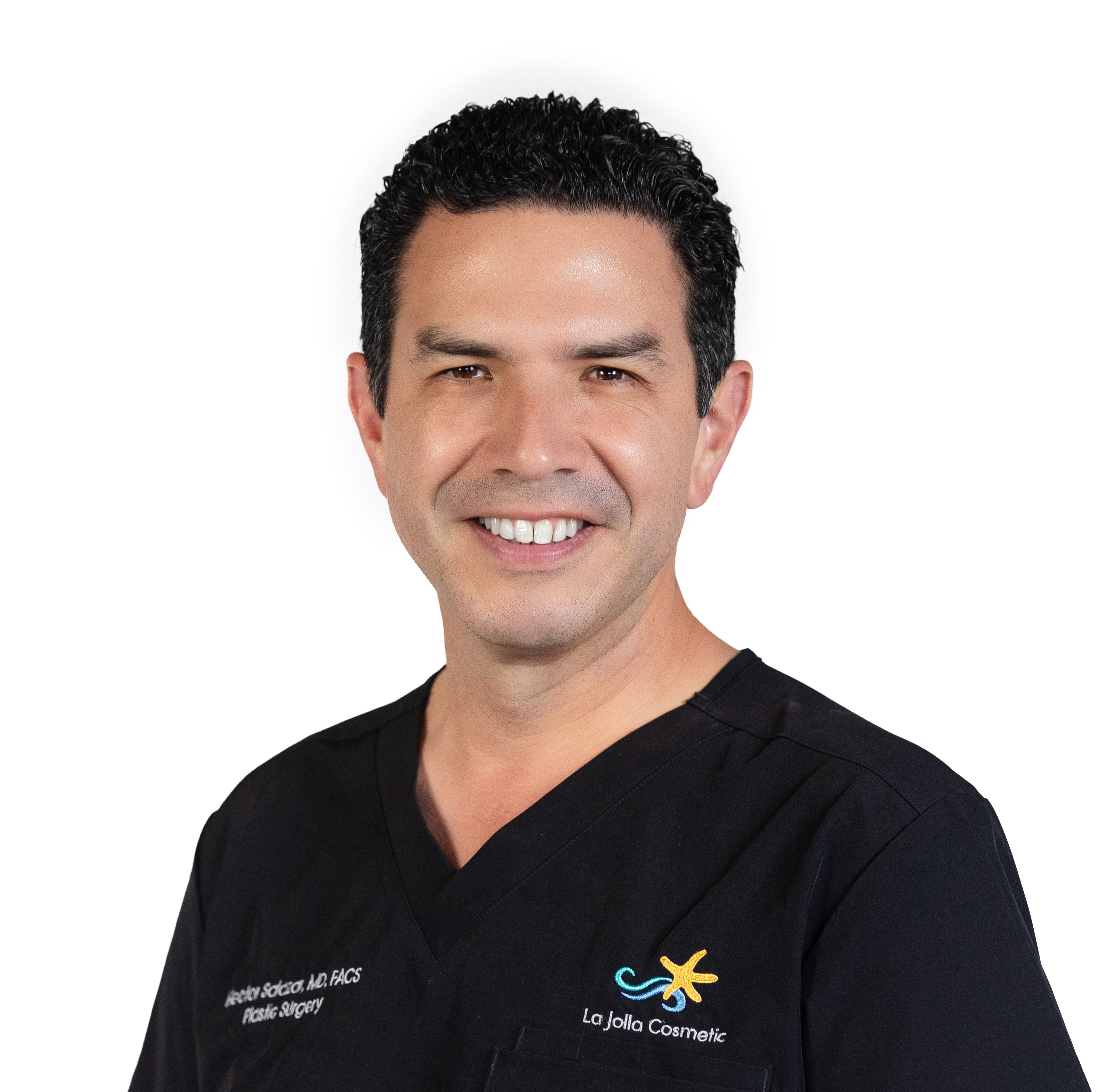
Having dedicated 17 years of his life to achieve the best medical training, Dr. Salazar’s philosophy is centered around providing beautiful results safely and ensuring each and every patient feels well cared for from their first appointment to their last.
In addition to being an American Board Certified Plastic Surgeon, Dr. Salazar is a member of the American Society for Aesthetic Plastic Surgery (ASAPS), a prestigious organization that is highly selective with its membership. Only plastic surgeons who demonstrate a high level of skill, experience, and expertise in aesthetic plastic surgery and cosmetic medicine are inducted into ASAPS.
Dr. Salazar is also a Fellow of the American College of Surgeons, an active member American Society of Plastic Surgeons, American Board of Plastic Surgery Maintenance of Certification Program, California Society of Plastic Surgeons, San Diego Plastic Surgery Society and the American Medical Association.