Lipo or tummy tuck—how do you know which one you need? San Diego plastic surgeon Dr. Hector Salazar and Monique talk through the difference between liposuction and a tummy tuck, and why the right choice isn’t always obvious. Skin quality, muscle...


Lipo or tummy tuck—how do you know which one you need?
San Diego plastic surgeon Dr. Hector Salazar and Monique talk through the difference between liposuction and a tummy tuck, and why the right choice isn’t always obvious. Skin quality, muscle separation, and deeper layers like fascia all play a role in what will give you the result you want.
They get into body contouring scars, recovery, why “less invasive” doesn’t always mean better, and where options like Renuvion and fat transfer come in.
If you’re trying to figure out what you really need to make your tummy flatter, this conversation is a good reminder: it’s not one-size-fits-all, and having a surgeon you trust makes all the difference.
Links
Read more about La Jolla plastic surgeon Dr. Hector Salazar-Reyes
Learn more about tummy tuck and liposuction
Listen to our episode about Dr. Salazar’s signature BellaButton tummy tuck technique Why Your Belly Button is the Most Important Part of a Tummy Tuck
Listen to our episode about plastic surgery incisions Why Scars are a Trade-Off You Won’t Regret
Learn from the talented plastic surgeons inside La Jolla Cosmetic Surgery Centre, the 12x winner of the San Diego’s Best Union-Tribune Readers Poll, global winner of the 2020 MyFaceMyBody Best Cosmetic/Plastic Surgery Practice, and the 2025 winner of Best Cosmetic Surgery Group in San Diego Magazine’s Best of San Diego Awards.
Join hostess Monique Ramsey as she takes you inside LJCSC, where dreams become real. Featuring the unique expertise of San Diego’s most loved plastic surgeons, this podcast covers the latest trends in aesthetic surgery, including breast augmentation, breast implant removal, tummy tuck, mommy makeover, labiaplasty, facelifts and rhinoplasty.
La Jolla Cosmetic Surgery Centre is located just off the I-5 San Diego Freeway at 9850 Genesee Ave, Suite 130 in the Ximed building on the Scripps Memorial Hospital campus.
To learn more, go to LJCSC.com or follow the team on Instagram @LJCSC
Watch the LJCSC Dream Team on YouTube @LaJollaCosmeticSurgeryCentre
The La Jolla Cosmetic Surgery Podcast is a production of The Axis: theaxis.io
Theme music: Busy People, SOOP
Announcer (00:00):
You're listening to The La Jolla Cosmetic Podcast with Monique Ramsey.
Monique Ramsey (00:05):
Welcome back everyone to The La Jolla Cosmetic Podcast. I'm here with Dr. Salazar today, and we're talking about, can you do lipo instead of a tummy tuck? Surgeons hear that question all the time. Is it skin? Is it fat? Is it muscle problems? So we're going to figure that out today. We're going to dive in and welcome back, Dr. Salazar.
Dr. Salazar (00:28):
Thanks so much, Monique. Thanks for having me. I would say that this is going to capture a lot of the attention of our audience. And you'll see the patients come here all the time because they hear about lipo, they hear about a tummy tuck. Nobody wants a tummy tuck. Everybody wants something that's kind of minimally invasive and make me look flat. And definitely it's a matter of us diving deep into this topic. And probably this is going to give some light to some of the potential patients that are considering having surgery. But as you know, the best answer is to give us a call and come and get evaluated in person.
Monique Ramsey (01:05):
Right. Right. Exactly. So I think also there's layers of tummy tucks. There's different levels, whether it's a mini, a full, extended flur deli. And we have podcasts that go deep into the different types of tummy tucks. But I think for most of us, lay people out there, prospective patients, if we're just unhappy with our abdomen, I just want my stomach flat. I want it flatter. What are the main things that you're looking at first?
Dr. Salazar (01:35):
I think that you just hit the nail right there when you said the common request is I want my abdomen flat.That's the biggest between flat and flat dur.That's actually where this topic comes in. Because what happens is we got to remember and refresh our audience about the different layers because you have skin. Then behind the skin, you have a layer of fat. Then behind that layer of fat, you have the fascia. And remember that the fascia is the layer that actually provides most of the structural strength. We tend to think that it's the muscle.
Monique Ramsey (02:20):
Right. We're always doing the crunches, right? And we got to get the muscles
Dr. Salazar (02:23):
Tight. Get the muscles strong. And yeah, the muscle is behind the fascia. So we go again, we start from the surface and we have the skin, then we have fat. Then we have behind the fat, the fascia. That's the strong layer. That's the layer that's going to provide strength. Then we have the muscle. The muscle can be strong or weak, but still is not going to provide the structural strength of the barrel, if you want to think about it that way.
Monique Ramsey (02:50):
Okay.
Dr. Salazar (02:51):
Because you can have strong wood, but you need those rings to keep the barrel tight. And then over here, the rings are basically the fascia. Okay? And then behind the muscles, then you have basically all the organs. And it's important also to give some value to those organs. And the reason why I say that is because they're organs, they have volume. They can even have sometimes fat around them. So that, the organs generate some weight and those organs need to stay and live comfortably in a space. So as those organs are sitting down and we are living on planet earth and there's gravity, then those organs are going to be creating and generating some pressure when we're standing up towards the front, right? Because that's going to be where the weakest point is. It's not going to go towards your spine back there. It's going to be towards where it's soft. And then that's why when we are in front of other people, we always like to stand up straight and tuck it in, right?
Monique Ramsey (04:07):
You don't have any to tuck in, but the rest of us pretty much do. So what are some of the clues? Is it pinching that people need to do to find out? Is it that you haven't worked out enough and it's the sit-ups or what? How do you know?
Dr. Salazar (04:24):
Right. So what we do is, and that's part of the evaluation. When I'm evaluating patients, I'm taking away ... When I give a pinch, I have to take away the thickness of the skin because remember, the skin of your eyelid or the skin of the dorsum of your hand is very thin. It's the thinnest skin of your body, but the skin of your abdomen and the skin of your lower back is among the thickest skins of your body.
(04:58):
Because the classic is even a patient that's thin sometimes grabs and then gives a pinch and they say, "Look at all this fat." But in reality, you're sandwiching skin, skin, and maybe a little bit of fat. So that's one of the components when I'm evaluating a patient in clinic that I truly have to determine how much fat is there. So how much skin, how much fat. Then I go in my evaluation deeper and I try to determine how good the fascia is, how much that rubber band that we have containing us has been stretched and how lax it is. And then lastly, we try to evaluate then the muscles and then which are not very much important for this part against all what we have learned and believed all of our lives, and then the internal fat portion and your organs. So those are all the different layers that when a patient comes in, we're evaluating to try to see which is the part that's either excessive or missing or lacking of strength or lacking of structure so we can plan how we can address it.
Monique Ramsey (06:14):
Would you say of women who have had children, in your experience, what percentage really do need muscle repair because the pregnancy makes those muscles sort of separate and they need to be put back together?
Dr. Salazar (06:30):
And remember, the six pack muscles, right? I mean, you've got the abdominal erectile muscle. So those are the ones right in the middle. Everybody can picture that and they're very, very close. If you close your eyes and you picture the most perfect six pack, you can see that it's like the muscles are really, really close in the middle, but there's still like a little divot in between them, right? But that divot, it's very, very, very, very thin. They're very, very close together. But remember, they're close together not because they're weak or strong or thick or thin. They're close together because there is a fascia on top of them, keeping them close together. And then again, think about that fascia, that layer as a rubber band. Then you have either pregnancy and pregnancy of, imagine this, twins. So there's going to be a lot of volume, distending, separating, stretching, stretching that rubber band, right, making it bigger.
(07:39):
And then once delivery happens, what you are hoping is that that fascia snaps back and then you can either start praying or you can look and talk to your mom and grandma and you can-
Monique Ramsey (07:54):
Look at their tummies.
Dr. Salazar (07:56):
Start assessing all the tummies of all the aunts in the family because that's going to dictate a lot what your fascia's going to do. And of course, having healthy diets, having good collagen, having good proteins, all that's going to help. And also, I'll never speak against exercising because exercise is excellent. It's good and it's required and it's a must. But once you start shrinking, there's no way that you can exercise extra skin and there's no way you can exercise the fascia. You can exercise the muscles, right? So you can do the best that you can do on your own for whatever you can influence, which is keep your muscles strong, keep a healthy diet, keep a healthy life. But then maybe even despite of all that, your rubber band was either stretched too much or the rubber band was not a good quality and it's not your fault, right?
(08:56):
Then that's when you go and talk to your ancestors. But that is a component that, I mean, we always, and when I say we, speaking about civilians, speaking about an average patient, a person that's considering having surgery, I've never ... I mean, it's really hard for me to encounter a patient that comes in saying, "You know what, doctor? I have a little bit of extra skin. I have basically no fat, but my fascia, I think that it's very lax. I think it needs to be repaired." Right?
Monique Ramsey (09:29):
Right, right.
Dr. Salazar (09:31):
Remember, this is not only for women. Also, we see it in men. Men could have poor quality fascia, right? Rubber band that it was not made out of great quality. The other situation is men can also gain a lot of weight and you can gain some internal fat component with where the organs were. Remember, we were talking about don't take away the credit for the organs, don't take away the credit for the fat that's internally. So you can stretch your abdomen as if you had a 10 pound baby, right? Yeah. And then you're stretching the rubber band and then- It's
Monique Ramsey (10:09):
The beer belly.
Dr. Salazar (10:10):
It's beer belly. It's a beer belly. And then you go back and you start exercising like crazy and then you deliver the baby and now you go through the same process. So the fascial component, we need to assess that on man, we need to assess that on female patients.
Monique Ramsey (10:29):
Now, who would be a perfect candidate for liposuction alone?
Dr. Salazar (10:35):
A patient that has good fascial strength, that has some fat trapped in the subcutaneous tissue that has good quality tissues to snap back and does not have extra skin. And if all those are there, the patient's going to have a spectacular result. Now, on the other hand, let's think about a patient that has all the conditions that we mentioned, but her fascia is a little bit lax. Okay? So when we do and we say, "Oh, let's relax your abdomen," and then boom, kind of that, a little bit of belly comes out and then with the belly a little bit out, we pinch and then we still feel that there's some fat there. If we talk to the patient and say, "Look, your skin is good." So if we remove some of the fat that's underneath your skin, above your fascia, underneath your skin, this layer here is going to be thinner, but you're not going to have a very flat abdomen.
(11:44):
You're going to have a flatter abdomen, as you were saying, Monique. And if that's their goal, and if they do not want to have their fascia tightened, then that's a perfect operation because those patients, are they going to have the abdomen they had when they were 16, 17 years old? Absolutely not. But are they going to have a thinner abdomen? Are they going to look better in clothing? Yes. Are they going to have super tight, flat, straight abdomen? No. So once you explain that to them and they say, "You know what? That's exactly what I'm looking for. I want to have a thinner abdomen. I'm not looking for perfection in my fascia. I know that I could aim for that, but I know that I'm not going to get it. Let's go and have and do some liposuction."
Monique Ramsey (12:35):
Yeah, so it's part of the way.
Dr. Salazar (12:37):
Exactly.
Monique Ramsey (12:39):
And would there be any situations where liposuction could make things worse?
Dr. Salazar (12:45):
Liposuction making things worse would be if you already have extra skin and then you remove more fat, so you're going to have looser skin. If skin is already hanging, the skin is going to hang more because the skin is going to be hanging for a reason. And the reason is that it did not snap back from whatever event, pregnancy, weight gain, et cetera. So if you do liposuction, you're going to make it worse. And I would say that that's where liposuction wouldn't be very friendly.
Monique Ramsey (13:17):
Now, where or when, I should say, when does somebody cross the line from maybe like, maybe lipo, but is this really a tummy tuck situation? You're just going to go in. Do you actually sort of palpate the push and have them contract and things like that? Is there an exercise you have them do in the consultation?
Dr. Salazar (13:39):
Let me reverse your question a little bit and say, what are the benefits of a tummy tuck? Because that's when you see if a patient would get all the benefits from a tummy tuck, then maybe a tummy tuck is what the patient needs instead of trying to find other solutions. So a tummy tuck will get rid of all the extra skin, number one. If the patient has multiple stream or stretch marks, the tummy tug will get rid of most of them. So you have a second benefit there.
Monique Ramsey (14:14):
That's nice. Yeah.
Dr. Salazar (14:15):
Another one is if there is some skin hooding above the belly button above the umbilicus, a tummy tuck will resolve that. Then if a patient has separation of the muscles, muscle diastasis, meaning the fascia has stretched and you need to repair it, then the patient will benefit from a tummy tuck. So when you see all those stars lining up and the patient's there, that's when a patient hears from me saying, "Well, if I were writing a book chapter on tummy tucks, I would ask your permission to be figure 1A when you have that first picture, the perfect candidate for a tummy tuck. Why? Because you get all the different benefits about it. " As you start trying to work your ways around to try to avoid a tummy tuck, then you're going to be leaving some things on the table, right? Either you don't remove the extra skin, either no, what you're going to do is you're not going to give the patient a flat abdomen because you're not repairing the fascia.
(15:30):
You can remove some skin, but then the hooding on top of the belly button, but it's still going to be present. And so that is, I would say, the way we can work things, like seeing it in a different way. And the other thing, speaking of quickly touching on the incision, a mini abdominoplasty is a limited incision. When you talk about a regular abdominoplasty, you're talking about a much longer incision, and it's as simple as it sounds. The longer the incision, the more skin you can remove, the shorter the incision, the shorter the area that you're going to be impacting. And then lastly, that in order for you to be a great candidate for a mini abdominoplasty, then the muscle separation, that fascia laxity should be present only from the belly button down because with a mini abdominoplasty done in a traditional way, you're not going to be addressing the separation of the muscles above.
Monique Ramsey (16:28):
Yeah. And I think, is it that patients, are they trying to avoid the scar? Or what is it that if people are sort of resistant, they're trying to figure out what other ways, is it just the scar that they're worried about and how can you help them understand scar placement and healing and how that might not impact them the same way in reality as it does in their brain?
Dr. Salazar (16:51):
So incision length, yeah, that's number one. When they see or when they come in and it's like, "No, just a liposuction and then perfect. I hope that we can just do it that way. Let me assess you. " We start discovering all those other ingredients, all those other elements that we now, all the audience knows now and we've agreed on. And then we say, "Okay, so you know what? You would be a much better candidate for an abdominoplasty." And then, "Okay, so show me the incision because I've already ... I thought about it. I don't want the idea of being like that magician that cuts the beautiful lady in half, having that incision, that doesn't appeal to me. " So we go over, we looked at the different scars, we looked at the length, we understand together why the length of the scar. And once I explain that to patients and make it evident, they understand the length, but still, am I going to be showing it?
(17:52):
Then what we discuss is that, yeah, if you take all your clothes off, yes, the incision's going to be there. Once you're wearing a two-piece bikini, it's not going to be showing. Or once you're wearing ... And the classic answer to that is like, "I don't wear a two-piece bikini." I said, "You will after the abdominoplasty." Or a bathing suit of a one-piece, right? So what you do is you mark the underwear the day of surgery, you mark the two piece. And some patients actually, they make adjustments. The day of surgery, they say, "Normally my bikinis, the way I wear them is like this. Would you mind trying to hide the incision as much as you can following this pathway pattern?" And we ask them to bring that and then we mark it and then we place our incision there. Some patients want it higher, some patients want it lower.
(18:43):
The only thing is you're committing, right? You commuting higher or lower because incision's going to be there. So that's on how to hide it. And the other thing, remember, plastic surgeons, we're not masters. We're not masters of doing things without incisions, but we're masters of closure of incisions in the most elegant way, in the most elaborated way. We spend a long time. I would say maybe I'll venture to say that 50 to 60% of the time of all of our surgeries, it's just dedicated to close the incisions. So we put a lot of effort into closing the incision in several layers that decrease tension. Low tension means better scarring and using fine threads, using fine sutures, small needles. So we do all that. We guide patients throughout the recovery. We ask patients to massage the scar. We teach them how we provide what they need for that massage.
(19:49):
In addition, we have other tricks that we share with them. We ask them to wear sunscreen. We also ask them to get some silicone pads, some silicone sheets. The other things, I mean, other things that we have done lately, we started using Nanofat inject it directly, which provides all the good chemical signals for repair. And it's already there. The way I like to think about it is you already bring the bricks for the construction workers to start doing their job and you're injecting them right there. That's kind of neat.
Monique Ramsey (20:25):
That's really cool.
Dr. Salazar (20:25):
That's really cool.
Monique Ramsey (20:27):
I think sometimes we as patients really do create a lot of crazy stuff in our head, or we go down some internet path of looking at weird scars or weird ... I don't know. A lot of times it's just talking it out with the surgeon and planning and understanding why they're there. And then all these kind of tricks that like the nanofat or silicone sheeting or ... I mean, there are a lot of ways to help your body create a nice scar. And it is up to your body a little bit too, right?
Dr. Salazar (21:02):
One thing, this little inside information that I share with patients when they're really concerned about the length of the scar, because they tell me, "Why should reach over here? Why couldn't you make it shorter, make it smaller?" And something that I share with them is, remember that whatever I cut, I have to close. And if there is some tissue that's bunching up or if there's some tissue that we're leaving behind, and just by extending the incision, even though it's going to cost me more time, it's going to cost me more effort, I have to work harder, patient's going to be happier, patient's going to look better, I'd rather do that than to say, "Oh, up to here, we're just going to stop right there. And what about all this tissue here?" Well, I got paid to do up to here. It doesn't work that way.
(21:57):
So if you ever see that your incision is a little bit longer, think that the only thing that I was thinking about, it was not that I was ... I turned into a, I don't know, like a blood thirsty monster in the operating room. It was only to give you a better result.
Monique Ramsey (22:14):
Well, as you're talking about that, I'm thinking about, you know when you make the bed, okay, let's pretend you've got a king bed.
Dr. Salazar (22:20):
Exactly.
Monique Ramsey (22:20):
And if you went and kind of crawled up the middle and you pull all the sheets and the blanket up to the top and you make it nice and smooth and nice and straight and nice and taut, but you don't do the sides, you're left with it's still unmade. And I feel like same with your tummy, if you have this lovely, straight, flat thing and then you've got stuff on the edges, that's not going to make you happy if then all of a sudden you've got a different problem and you started with. And so that brings me to the idea of some patients need to get to their goal of this flat, beautiful new body, an extended tummy tuck where it's not maybe hip bone to hip bone, it's going to go and wrap around a little further. And in what patients are we deciding or could they have lipo in that area instead?
(23:17):
And so what is kind of the talk that you go through with them to assess sort of the pooches on the side?
Dr. Salazar (23:25):
So the pooch is on the side and the lower back. So somehow if we all kind of close our eyes right now and think about how the skin and the quality of the tissue in the lower back, it's kind of tighter. It's much better than the tissue in the front, right? I mean, it is what it is. So you can get away more frequently by just doing some good liposuction in the lower back. The tissue will snap back because now we know, Monique, now you know exactly how to do it, right? If the tissue, if the skin is not hanging in the lower back or the love handles or however people like to call it, but if the tissue is not already hanging, has better quality, there is some fat, let's just get away with some good liposuction of that area. So then what we do is we do an abdominoplasty, meaning tummy tuck in the front, if that's what's needed, and then we go and we do some good, nice liposuction to the back, and that's it.
(24:31):
If there is already some hanging skin in the lob handle area, and we know that if we just stop right there, we're going to make it worse, meaning if our incision that goes from the front all the way to that, the sides, then we're just going to make it worse and then just have like two chunks of skin, then what we will do is then we would recommend, you know what, let's wedge it out. Let's kind of land. Instead of a firm landing, let's kind of do like a little soft landing. And what that implies is yes, extending that incision, but it would be only for the own benefit of the patient. And then just to be thorough and cover it all, there's some patients that have extra skin, not only at the bottom, but also at the top, right underneath the breast, right in the center of the abdomen.
(25:28):
And then those patients can benefit from a fluoride abdominoplasty, which is adding another incision along the midline. But that's very extreme and that's for patients that normally you're talking about that they've lost 100, 150, 200, 250 pounds, and they've developed a lot of extra skin that otherwise you couldn't get rid of it. And if you do a regular abdominoplasty, you're still going to have some extra skin there. And then Monique too, so we don't forget the second component because the first component that we said, why would people try to "get away from a tummy tuck or what would be discouraging?" One was the incision, the second one is the recovery. Let's say when we do liposuction, we restrict patients from exercising for about two weeks, depending, right? I mean, we follow them very closely and then we start releasing them to go and do certain exercises, cardio, et cetera.
(26:22):
But when patients have a tummy tug, when patients have an abdominoplasty and we repair the fascia and we brought it together, we don't want any heavy weight lifting more than a gallon of milk, that's heavy. So we don't want that for six weeks because initially the repair, it's only a mechanical repair. Our stitches, basically that's it. So you can easily tear those stitches if you start lifting grocery bags with a couple of gallons of milk and all that, everything else that's being contained in there. So I think that's the second component, the ability to recover. And is there more discomfort involved with a tummy tuck than with lipo? Absolutely. I mean, the recovery really from liposuction, I mean, I just saw a patient that we did liposuction yesterday. She looked like nothing happened. I'm not over promising. She's an exception, but you never see that on a tummy tuck.
(27:21):
There's not a single patient that walks in partying and feeling that- Like nothing happened. ... nothing happened, right? So the patient walks in, they're protecting their abdomen, they really feel it. And even though we do multiple things to alleviate and make it easier, their pain, we inject some medication like when you go to the dentist and they inject you with local anesthesia. So we do a local anesthesia on site when we are operating, but that lasts for 72 hours.
Monique Ramsey (27:49):
That's nice.
Dr. Salazar (27:50):
That's really good pain relief. And then we attack the pain component from five different directions with different medications and we tell them how to combine it and all that. But still that first week, it is what we all imagine as we're recovering from surgery.
Monique Ramsey (28:07):
Okay. Now I have two more little finishing touches that you were talking about. So you talked about nanofat and you talked about what does that mean and how does that help the scar? So it's sort of the building blocks that help your body recover, but where do we get the nano fat from?
Dr. Salazar (28:24):
So the fat is like, let's say we're doing a tummy tuck and we're doing tummy tuck with liposuction or even without liposuction, but there is some fat right there, right? We're seeing the fat. So the only thing we need to do is we know this. We know that fat has good regenerative properties and we all know this. So what we do is we break the fat, pass it through filters, we steal a little bit, and then we pass the fat through filters. And then just before we close the last layer of skin, we inject that nano fat. Nano, it's because it gets passes through filters. And the last filter, it's the nano filter for nanoparticles. And that destroys the fat cells because we don't care about the fat cells, but we care about the factors that are around those fat cells. And then we go and inject and we have seen very nice results of patients healing in a, let's call it faster, nicer way.
Monique Ramsey (29:23):
Okay. My second little question about a finishing touch, and maybe it's totally wrong, I don't know, but I know we have something called Renuvion, and is Renuvion ever part of anything we've talked about today?
Dr. Salazar (29:39):
So it's high radiofrequency energy, right? So it's a type of energy that's going to generate some heat and that heat, it's going to help the tissue contract, like shorten collagen fibers, retract. What Renuvion does, it helps with the shrinking process whenever there is starting of loose skin Or a skin that you think is going to be struggling when you're expecting some tightening. If you foresee that and you do some liposuction and add that component, you're going to see how it shrinks back better, but it's not going to make extra skin disappear. And at the same time, it acts mainly on your dermis and subdermal tissue, but it's not going to be tightening the fascia enough to make it flat and tight the way a tummy tuck would do.
Monique Ramsey (30:38):
Well, thank you, Dr. Salazar.This was fun. And you said it kind of started all from some of your patients lately who've been coming in with kind of the same questions.
Dr. Salazar (30:49):
Somehow things sometimes happen in tandem or have ... There was a wave of patients probably the summers getting close and patients want to get ready for that. And then we have some sort of a, I don't know, some sort of a rally of patients all with the characteristics of maybe you would benefit more from a tummy tuck than from just liposuction.
Monique Ramsey (31:14):
And I will also say, and we have some great episodes and we'll put them in the show notes, but we also have one just talking about the bella button, which is the tummy tucks belly button. Some people don't love that. They see people on the beach and they go, "Oh, that's weird. Why does it look like that? Maybe they had a tummy tuck without a bella button." And so that bella button and having that really natural, beautiful little belly button that you can bring them.
Dr. Salazar (31:44):
And we also have an episode about incisions. Remember? We had a nice conversation about those incisions. I now was talking about longer or shorter, but there is a great episode on incisions. I love that.
Monique Ramsey (31:55):
Yeah. So, okay. We'll put all that in the show notes. So thanks everybody for listening. If you have any questions, send them our way and you can go onto the lajollacosmeticpodcast.com and you can sort by topic. You can sort by guest. You could see all of Dr. Salazar's episodes all in one place. You can also do that on YouTube, which you could see all the things about tummies and lipo right in one spot. So thanks again everybody for listening and we'll see you on the next one.
Dr. Salazar (32:25):
Perfect. Bye. Thanks, Monique.
Announcer (32:30):
Take a screenshot of this podcast episode with your phone and show it at your consultation or appointment or mention the promo code PODCAST to receive $25 off any service or product of $50 or more at La Jolla Cosmetic. La Jolla Cosmetic is located just off the I- 5 San Diego Freeway in the XiMed Building on the Scripps Memorial Hospital campus. To learn more, go to ljcsc.com or follow the team on Instagram @LJCSC. The La Jolla Cosmetic Podcast is a production of The Axis, T-H-E-A-X-I-S.io.
Plastic Surgeon
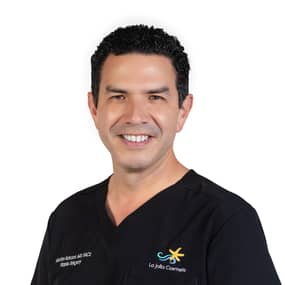
Having dedicated 17 years of his life to achieve the best medical training, Dr. Salazar’s philosophy is centered around providing beautiful results safely and ensuring each and every patient feels well cared for from their first appointment to their last.
In addition to being an American Board Certified Plastic Surgeon, Dr. Salazar is a member of the American Society for Aesthetic Plastic Surgery (ASAPS), a prestigious organization that is highly selective with its membership. Only plastic surgeons who demonstrate a high level of skill, experience, and expertise in aesthetic plastic surgery and cosmetic medicine are inducted into ASAPS.
Dr. Salazar is also a Fellow of the American College of Surgeons, an active member American Society of Plastic Surgeons, American Board of Plastic Surgery Maintenance of Certification Program, California Society of Plastic Surgeons, San Diego Plastic Surgery Society and the American Medical Association.