


Dr. Salazar returns to share how HD Lipo has evolved over the last five years and why realistic expectations are just as important as technology.
Learn about HD Lipo recovery timelines, the importance of compression, how long it takes to see results, and why choosing an experienced plastic surgeon is critical for outcomes that look natural.
From candidate selection to long-term maintenance, hear Dr. Salazar’s honest look at what HD lipo can and can’t do.
Links
Read more about San Diego plastic surgeon Dr. Hector Salazar-Reyes
Learn more about HD lipo
Listen to our previous episode, Plastic Surgery Doesn’t End When the Procedure is Over
Learn from the talented plastic surgeons inside La Jolla Cosmetic Surgery Centre, the 12x winner of the San Diego’s Best Union-Tribune Readers Poll, global winner of the 2020 MyFaceMyBody Best Cosmetic/Plastic Surgery Practice, and the 2025 winner of Best Cosmetic Surgery Group in San Diego Magazine’s Best of San Diego Awards.
Join hostess Monique Ramsey as she takes you inside LJCSC, where dreams become real. Featuring the unique expertise of San Diego’s most loved plastic surgeons, this podcast covers the latest trends in aesthetic surgery, including breast augmentation, breast implant removal, tummy tuck, mommy makeover, labiaplasty, facelifts and rhinoplasty.
La Jolla Cosmetic Surgery Centre is located just off the I-5 San Diego Freeway at 9850 Genesee Ave, Suite 130 in the Ximed building on the Scripps Memorial Hospital campus.
To learn more, go to LJCSC.com or follow the team on Instagram @LJCSC
Watch the LJCSC Dream Team on YouTube @LaJollaCosmeticSurgeryCentre
The La Jolla Cosmetic Surgery Podcast is a production of The Axis: theaxis.io
Theme music: Busy People, SOOP
Announcer (00:00):
You're listening to The La Jolla Cosmetic Podcast with Monique Ramsey.
Monique Ramsey (00:05):
So this is one of those episodes we've been meaning to revisit. We talked HD lipo with Dr. Salazar five years ago, but between new technology and changing patient goals, we think it's time for an update. So today we're getting into high definition lipo, how it works and who does it benefit the most. So welcome back to the podcast, Dr. Salazar.
Dr. Salazar (00:28):
Thank you so much, Monique. And for how long have we been talking about this to revisit this topic that many, many of our patients are interested in? And I feel that HD liposuction help patients achieve their goals and boost their body image like no other surgery.
Monique Ramsey (00:51):
Interesting. So when we did that episode, it was back in 2021 because we're coming up on the five-year anniversary of this podcast, which is amazing. So what has maybe changed the most in your approach? Because for you at that time, you had gone off to Europe, I believe, to learn how to do it. Remind everybody a little bit about your training and why this is sort of a special type of liposuction, and then in the five years, how your approach has changed, if at all.
Dr. Salazar (01:22):
Yes. As a matter of fact, you know that all my background and training was throughout all my plastic surgery training, it was extremely heavy in cosmetic surgery, of course, including all the different techniques of liposuction. But when I started practicing, I always wanted to take liposuction to the next level, do a little bit more, more than just body contouring, but to do that muscle edging. HD liposuction, that's the technique that actually allows you to do that. And a friend of mine, a plastic surgeon actually in Spain and Barcelona to be precise, him and I talk about this technique. He said that he had a couple of secrets that he wanted to share with me. And actually I took off and went there for a week. I learned from him in different ways how to perfection this technique. Then I came back and then I started doing high definition liposuction and offer it to our patients here.
(02:22):
As you know, still in Southern California, not many people do high definition liposuction. The other thing is that when I was looking into it, I wanted to do height of liposuction without an energy source, without vaser, because of the possibility of having some thermal injuries, some burns. And we found the perfect system, which is the PAL, power assisted liposuction, which is it's a liposuction in which you have a handle that pistons in and out. And that allows you to break the fat and allows you to treat the tissue in a way that it's going to shrink back a lot. And then later we'll touch more about this. So we had the new technique. We brought it here to San Diego, brought it to La Jolla, started doing cases. We started getting many, many patients very, very excited. And I would say that mainly it is, and we have found that little by little, this technique has been preferred by men, by male patients that want to edge those muscles.
(03:30):
And we've had different patients looking for different goals. Some patients actually are looking for to have a very chiseled look. Some patients have actually want to just help them getting a little bit more definition that they say that they're working out and they cannot achieve the level of definition that they want. We've had other patients coming in looking to tighten all that belt area and HD lipo is fantastic for that. So it is a very powerful technique. And we started, as you were asking me, how the technique has evolved in this years. I would say that the technique, we've maintained it pretty pure as we learned and developed the technique. But one of the things that we've discovered is how powerful it is to allow the fascia to retract. And I think we have to clarify that for our audience, right?
Monique Ramsey (04:32):
Right, right. Let's talk about, so the fascia, as I understand it, is the layer that kind of covers the muscle. Is that right? Like if you were looking at a piece of beef.
Dr. Salazar (04:42):
Exactly. A steak.
Monique Ramsey (04:43):
You see that white, Yeah, like that white part that's over the muscle.
Dr. Salazar (04:48):
Right. No. And we tend to think that the strength of our abdomen, what keeps us together are the muscles. And we tend to think that if we exercise a lot, then those muscles are going to get super strong and that our abdomen is going to be flatter. What happens is I always tell patients, just to your point of on a steak, you see the muscle and then you see that white chart, rindy, tough part that if you take a knife and you go through the muscle, the knife goes like through butter, right? A good knife, sharp, then knife goes through it without a problem. But when you reach that white part, then even the sharpest knife starts having some problems. And that's because what keeps us together is that white part, which is the fascia. That is what actually is the structural part. The muscle is good to, when you crunch, it contracts and it has a lot of strength, but what really keeps us together throughout the day as you're standing up and walking around is the fascia layer.
(06:06):
And with age and also weight gains and weight losses, and sometimes in case of female patients pregnancies, what happens is you stretch that white layer and it's going to think about it like a rubber band. If you gain a lot of weight and then you lose it, so you've stretched that rubber band. Also, if it's an older rubber band versus a newer rubber band, right?
Monique Ramsey (06:32):
Isn't it great the way aging affects everything?
Dr. Salazar (06:36):
Exactly. You can go and get a fresh rubber band right now or look in your drawer and try to find a very old one and it's not going to be the same. Then so in our consultations rooms, you know that we have a great source that it's called TouchMD and we can go through not only pictures, but also anatomical diagrams. And we have many, many instruments for patients to be able to visualize and understand it. And we explain to them that it's not so much their fault sometimes. It's not that they've ate too much fat and then they gain a lot of weight. No, sometimes it's just that fascia that has loosened a little bit and allows all your abdominal content, all your organs to kind of those ... I mean, you can imagine they have weight, they will create some pressure, and then that allows you to show it a little bit more.
(07:29):
So HD liposuction allows us to tighten that fascia and because of the repetitive action and what we do for liposuction, the patient little by little gets that fascial tightening. And at about three months, that fascial tightening shows, it starts to show about three weeks, but then you have the final result at about three to four months, and it is impressive.
Monique Ramsey (07:56):
It is.
Dr. Salazar (07:58):
I mean, I invite patients to come in and take a look at some of those pictures that we have.
Monique Ramsey (08:03):
So this is kind of that whole concept of the six pack and that amazing definition of the six pack and the V in front for a man, or even maybe sometimes are you ever doing any etching on the back?
Dr. Salazar (08:18):
Yes, Absolutely. The lower back, the latismus dorsi muscle, the largest muscle in the back, we edge it. And then we demarcate a lot on that lower back and the transition between the booty and the lower back. So sometimes, I mean, I like to give this analogy of a mountain in a valley, of the mountain being the booty and the valley being the lower back. So if you dig a little bit more on the valley, the mountain looks a little higher, so that even works well. So in the back, we concentrate on the lower back a lot. And then you see how you go from convex, not only to straight, but sometimes you start going concave back there. And so we work on the latismus dorsi muscle on the lower end of the back. We pretty much empty as much fat as we can remove from that area. We sculpt the muscle on the front, the Apollos line, what you were mentioning, that sexy line that goes into the groin, the linear alba, linea simulinaris, those are basically a fancy way of saying the outside of the six pack and the inside of the six pack or the midline. And then the muscle inscriptions, which another fancy word to say, the six pack, so like kind of the vision of the pack and patients respond really well and it takes, it is a process, it's a little bit more involved at regular liposuction, it's a little bit longer surgery, but patients have obtained a result that they love it. They love it. And they want to maintain it. That's something that it's impressive.
Monique Ramsey (10:09):
We have, and we'll put in the show notes several things. So I'll put a link to the HD lipo page where we talk about the procedure and it has before and afters there, but we also did a progression of, and it's on that page, of one of your patients who came in and had the surgery. And then he came back when we were doing a big photo shoot with all our patients about a little over a year ago and he came back in and he said such amazing words. He said, and I heard it over, he was in the next room and he said, "Dr. Salazar changed my life." And I'm like, "Who said that? " I'm poking my head around. And it was him. It was your patient that you did the HD lipo. He said, "It helped me kick off my journey to ... " And he wasn't really overweight or anything, but it helped him be motivated to completely change his lifestyle, his diet, his exercise.
(11:09):
And three years, it had been three years since his surgery. And so I said, "Can we take another picture of you just so people can see?" Because sometimes they're off living their life and they're so happy we never see them again. And so we took another picture and he's like, "I eat differently." Everything about it for him was such a life-changing experience. And he was so bummed because the day he came in, you weren't there and he really wanted to tell you himself. So this etching you're talking about is what I remember, because I came into one or two of your surgeries and I did some filming and it's like two procedures in one in a way because you're having to debulk the area first and then you're going in and doing the artistic part of the etching and how does that work?
Dr. Salazar (12:02):
So part of the concept is that you have a deep fat compartment and a superficial fat compartment. Everything on top of the muscle, we're not talking about, when I say deep fat, we're not talking about the fat that's inside where the organs live. But basically what you're doing is, yeah, you're correct. You start with, let's say, doing traditional liposuction, which is mainly as you're saying, the bulking, removing the deep fat from that deep fat compartment, and then you go into the superficial fat compartment, and then you start the second part, which as you are correctly pointing out, is the artistic part in which you're now defining and emptying the superficial fat compartment in certain areas. And then in other areas, what you're doing is you know exactly where the end of the muscle is, and then you're doing some edging there. When we mark the patients before we go to surgery, and I always tell the patients this, it is not that we are creating any new anatomy for them, we are reflecting their true anatomy and we spend a good amount of time.
(13:10):
Normally, let's say before we go to surgery, normally we mark patients. For every single surgery, as you know, we mark patients, but on average, you spend four or five minutes putting some specific markings and using calipers and all that. But for this, we sometimes take about 10, 15 minutes because it's a very interactive ... It needs a participation of the patient because the patient's crunching, the patient's flexing, the patient's torquing.
Monique Ramsey (13:38):
You're like, Okay, I want you to bear down. I want you to tighten your abdominal muscles. And so the patient's standing there, because I was there for this, And then you're palpating around and making-
Dr. Salazar (13:49):
Exactly.
Monique Ramsey (13:49):
Was fascinating though.
Dr. Salazar (13:51):
Exactly.
Monique Ramsey (13:52):
But I think this is what you explaining that it's reflecting their own anatomy, I think is really important because if you think of a six pack, we think of the teenage mutant ninja turtles. It's like this very comical, very symmetrical six pack, whereas our own bodies are different, right? So you're following the lines of what they already have.
Dr. Salazar (14:18):
Exactly. And that makes it look so natural. And if our audience right now, for instance, go on Google and then they look online for like six pack, no shirt, man. And then you look at all those six packs, they're not going to be symmetrical at all. They're all going to be asymmetrical. We are asymmetrical. I mean, we're on camera right now and if someone is watching the podcast instead of versus listening, you can see our faces are very asymmetrical and that's the same way our body is. And that's what we need to respect in order for the result to look natural. And now that you're mentioning the teenage mutant ninja turtle look, all of our patients have very close to that look at about a week. So when they come in for their first office visit after surgery, what happens is we do the surgery, we put some special foam that compresses certain areas that we want, and we want that compression to stay in place for about a week without being disturbed.
(15:22):
If there is the need for us to take a look, we can. And I mean, safety is always our number one priority, but if there's nothing going on and the patient's recovering well and there's no need for us to take the dressings down, we leave them for about a week. And that's why I say it's very similar to your recovery to regular liposuction, but this is a little bit more involved because we don't let you take those dressings for about a week. So when we take the dressings for the first time, then you can actually see that little bit of that ninja turtle cartoonish look. And what I tell patients, and I prepare them for them to know that they're going to look funny that on that first visit, it's like too exaggerated. But then what's going to start happening is the swelling's going to go down.
(16:13):
On their third week, they look so much better. They still have some bruising. That cartoonish look starts to disappear. And as a matter of fact, the definition starts to disappear around that time. Then what happens is that you get the first part of the result of the surgery, and that is what the scooping out, removing the volume will give you, right? And then you can see that at about three to four weeks once the swelling goes down. But what starts around that time is patients start to say at about three to four weeks, they say, "Hey, doc, you know what? It feels very tight. It starts to feel like an under armor. It feels that I'm wearing some sort of compression garment internally. Is this normal?" I always prepare them for that phase, but they always, regardless, they'll ask. And then you feel it and it feels really, really tight.
(17:08):
And what I like to tell them is as long as you feel that tightness, imagine that there's a bunch of construction workers in there pulling and pulling and we celebrate that tightening and that tightness because it's going to allow all the tissue to shrink and retract. And that's the second part of the result that you get out of this. The framework is shrinking and shrinking and shrinking, and patients start to see that flattening of the fascia that we talked about.
Monique Ramsey (17:41):
Interesting. So as they're coming in, let's say you're coming in, you're thinking about HG lipo, how do you help them set expectations for what that result is going to be and sort of how long it takes to get to the end result? Because like you say, the recovery's a little bit more. And so how do you help get them ready for that?
Dr. Salazar (18:07):
So what we do is first we establish exactly what they're looking for and what are their goals. Then after that, what we do is we have to go through pictures and we go through the process. And I show them two or three different patients how actually they went from week one, I mean before week one, week three, week six, three months, six months. And as we go through that, then patients realize and see when will they feel comfortable taking off a t-shirt in front of their buddies, for instance, because that's a classic that, "Oh, I have a fishing trip or I'm going to go to Kabo with my friends or we're going to go to Hawaii." And so they have to time. I tell them, if you don't mind them asking you what happened, then you can go to a trip whenever you're ready to go after two weeks.
(19:03):
But if you want the result to be ready to go and for nobody to even suspect that you had anything done, just that you worked out nicely, then give yourself about three months. Just to confirm what we were talking about, remember the construction workers pulling and tightening, the construction workers tend to leave at about three months. So what happens is that tightening starts to happen about three weeks and then it gets so intense and about six weeks, the tightening's still there and it starts fading down. And then about three months, the tissue starts to soften. And that's when starting from three months to six months, then the next phase of the healing is just kind of your body on its own is going to start blending better and then blends with the rest of the non-operated areas and then it looks so natural, but it does take time.
(19:57):
And the other thing that we haven't talked about is the chest because also it's very frequent that we do it in combination with the chest in which what we do is we pretty much empty all the fat and maybe a little bit of breast tissue that patients can have from the nipple down. And then we work on the PECTrialis major muscle to give better definition. And sometimes we can also inject some fat to beef up that PECTrialis major muscle and allow it to look a little bit more muscular. So that's something else that some patients ask for and we can do it.
Monique Ramsey (20:34):
Yeah. If Mother Nature didn't give it to you, Dr. Salazar can give it to you. I mean, why not? So going back to the technology that you use. And so you mentioned, I do know that people over the years would like call and do you have vasor lipo like they think it's a great thing and it's, we don't and there's a reason. And then you were talking about PAL, the power assisted lipos So tell us. And then also I think Renuvion. Exactly. So can you walk us through that technology in the OR, what you use and what you don't use?
Dr. Salazar (21:06):
Right. So basically you have two goals. One is to remove the fat and two is for the tissue to shrink, right? Those are the two things that we want. And when I say tissue, I mean fascia, now we all know what that is and the skin because you don't want to have like hanging skin, like an envelope of skin that it's hanging and doesn't retract. So the power resisted liposuction has demonstrated to us that does it in a very nice way, achieves the goal of emptying the fat and achieves the goal. I mean, we use cannulas that are called five basket cannulas, I'm sorry, that are on the aggressive side of things, but those are cannulas that are great to remove the fat, are great to allow us sculpting. The cannulas that we use are always fresh cannulas so they can provide or perform their task in a better way.
(22:06):
And we have seen, and again, if our audience can go online and look how powerful it is and how much retraction we obtain, we feel in our hands adding Renuvion, which is another tool that we have. We do have it and we use it under different circumstances. It's not needed. We don't need to use Renuvion at the same time that we're doing high definition liposuction.
(22:34):
Renuvion, we pair it with other types of liposuction and sometimes it has helped us, Renuvion, to give or add additional shrinkage if a certain area we see after surgery that could have obtained a little bit more of a tightening and the patient's tissue is not giving it to us. And then we add, but at a different surgical time, we can add some Renuvion to those areas to allow the tissue to shrink more and the patient to obtain a better result. But I would say 90, 95% of the time we don't get Renuvion involved at all and we still obtain tightening. And just to clarify, Renuvion is a high rate of frequency energy device that allows tissue to shrink.
Monique Ramsey (23:25):
Got it. Now, how important is it for patients to have sort of a baseline muscle tone to get good results?
Dr. Salazar (23:35):
I would say it's not essential, but it's better, of course. It even allows us to find our muscles easier, but I would say it's not a must. One thing that sometimes a question that I get is, let's say that a patient doesn't have the culture of exercise and they don't exercise a lot. They say, "My God, doc, now I feel great and I'm eating more in a healthier way and I have a healthier lifestyle. I'm going to start exercise. I'm going to start toning my muscles a little bit more. Would that affect my result?" And no, it's only going to boost it because now we've removed a fat layer between your skin and your muscle that was making it harder for you to show your result. And because we've reflected the patient's own anatomy, then the results are going to continue looking good and more natural.
Monique Ramsey (24:35):
Now, who's the perfect candidate for this? Is it men and women? Is it mostly men? How do you say who's the right person to really benefit from HD lipo?
Dr. Salazar (24:48):
I would say both. Both can, you can apply this technique. What tends to happen is men tend to look more for this. I would say it's like 90% versus 10% maybe. And also men, they have thicker skin and the skin can take more as we are doing the liposuction and the tightening. Because remember, we depend a lot on the patient's tissues and the thicker the skin, the better it'll start tightening and the better result that you're going to be obtaining. So it's a partnership.
Monique Ramsey (25:26):
Yeah. Now, is there anybody who HD lipo is not for?
Dr. Salazar (25:31):
Well, I would say HD lipo and lipo in general, it's not a weight loss procedure. So I would say patients that actually have as a goal weight loss, they're not ideal candidates. Also patients that have morbid obesity, of course, they wouldn't be good candidates to undergo this procedure. Patients that wouldn't be healthy, they're definitely not good candidates. So I would say patients that are, and they don't have to be on their ideal weight, but they should not be in the obesity range in order to qualify for this.
Monique Ramsey (26:08):
Well, and I think now we have the tool of the skinny shot and Dr. Haas, in our practice, he's the kind of the director of our skinny shot program. And it's a great way to help you get to that ideal weight before a surgery, if that's something that has sort of been holding you back. I feel like it's a really nice tool to help say, "Okay, how do I enable this surgical goal that my dream six pack and chiseled pectoralis muscle, but I'm like 20 pounds overweight." So there's a really nice, easy solution. And so would you say that you want the patient at, let's say they were losing weight, how long do you want them at their goal before you operate?
Dr. Salazar (26:55):
Five plus minus five, 10 pounds, it's fine because the body and the tissues are not going to change that much. But if patients are looking to lose like 20, 25, 30 pounds, 50 pounds, it's not the right time to start considering this procedure.
Monique Ramsey (27:13):
Yeah. So the element of artistry, I know that comes into play no matter what procedure you're doing, because that's what you guys are, your artists in the OR, but would you say that that element is more at play in this procedure than other procedures?
Dr. Salazar (27:33):
Hard to say. It's kind of like try to pick your favorite kid. I would say hard to say because in everything we do, I mean, as you know, we're scientists first, then we're physicians, we're doctors, then we're surgeons, then we are plastic surgeons. And so you keep adding and adding different hats and jerseys that we wear. And in every single procedure that we do, there's all of that is involved and safety first, our medical eye is always there, then our surgeon eye and then our artistic eye. And you're talking about even anywhere from breast augmentation to a tummy tuck to a facelift to eyelid lifts to ... And in every procedure, there is some artistry. And in this, I mean, sometimes it's funny, great that you brought it up because when you see as a person that it's either not related to or close to what we do and you see a surgeon performing liposuction, it can look extremely, extremely either random or like look how randomly they're just moving the cannula or look how brutal that looks that like there's an instrument going in and out of the body, but there is a lot involved in doing that.
(28:54):
And that's why patients should go only to board certified plastic surgeons that trained in plastic surgery to have this procedures done, not to a physician that had a course over a weekend or that it's an ER physician or that is a pediatrician performing liposuction, that's not the right thing to do.
Monique Ramsey (29:19):
Yeah. And we did do an episode just recently on safety and some complications that were in the news. And so we'll put that link in the show notes too. It was very interesting. Okay. So they're going to be in that compression garment with the special foam for that first week and we're not touching it. Then how long are they in a compression garment and is there anything that a patient could do accidentally that might compromise their results?
Dr. Salazar (29:44):
Compression is key here and that first week twenty four seven, then we're still wearing it twenty four seven for the first six weeks. Then after six weeks, we ask the patient to start weaning it off. And then so the way they do it is they wear it every other day or they wear it just at nighttime or during the daytime. So those first six weeks they're going to learn when it bothers them the most and the least, and then they can pick. Another thing is that men are particularly reluctant at the beginning to wear compression. For some reason, women are more used to wearing something like an underbody something, and it's a little bit of a battle, but it is important that the patients follow up our recommendations. I would say if you would ask me, what's the success rate of this surgery? I would tell you close to a hundred percent.
(30:46):
And the one patient that I remember that shrinkage didn't occur the way we were expecting his results didn't got to where we normally like the results to get. It's because the patient took it off during that first week. He was not wearing it on week number two. He went snowboarding on week number three. So he was on and off and then he started wearing it after he came back to see us. And I think because you have this short window of time, because six weeks sounds like a lot, but it is in a lifetime, it's a very short window to influence in a positive way your results. And that's why we make it very aware of the importance of compression because it's key. Yeah.
Monique Ramsey (31:40):
So if down the line the patient were to stop working out or gain some weight, what happens to their result?
Dr. Salazar (31:48):
This is a great question. We have pictures of a patient that actually gained some weight and gained about 15, 20 pounds, and he sent us the pictures. And what you see is that the definition fades a little bit, starts to fade. The tissue starts to fuse. And this patient, he lost the weight back and he got the definition back right away. But it's really, really important for patients to literally, even if they're not as disciplined as they would like to be, that after this surgery, it's life changing. They feel that finally they have the look that they were looking for and that they were trying to obtain and now they have it. So now they literally behave like that. They want to take care of it a lot. And that's reality. I mean, when I see those patients, they don't gain weight.
Monique Ramsey (32:48):
That's interesting. Well, I can understand why. If you're in love with your result, you want to keep it, you want to keep it. So the last question I have for you is what questions should patients be asking to make sure that they're choosing the right surgeon for something like HD lipo, because it isn't something that just anybody does.
Dr. Salazar (33:09):
So I would say number one, board certified plastic surgeon, right? Number two, the surgeon that you're talking to makes you feel comfortable. Number three, that you go and review the gallery of pictures. Sometimes, again, maybe they're not going to have them online, maybe they're going to have to go and visit their office and go through those pictures with your surgeon, make sure that you ask them, "Are those your pictures?" Because sometimes God knows. And then go in and dig a little bit about the reviews of that physician, of that doctor and make sure ... We all have five star, four stars, three stars, two star, one star. Go in just the same way you do it for a restaurant and the same way you do it for a hotel that you're about to visit, you're about to book a reservation. And then you go in and then you read and then you can read the good, the bad and the ugly and then see and try to read between lines and all of them and the good, the bad and the ugly and see if that physician, if there is a problem, if you're going to feel comfortable with that person.
(34:22):
And I feel that that's the highest level of trust. If there is a problem, can I trust this person? I love when patients, the day of surgery or the morning of surgery, they say, "Dr. Salzar, I'm a little nervous." And I looked at them and I tell them, "You know what the great news are that I'm not. "
Monique Ramsey (34:43):
You're not nervous.
Dr. Salazar (34:45):
I'm not nervous. So it's totally normal for a patient and it's actually helpful because it prepares your body for recovery, right? I mean, you see a lion coming at you, so you immediately get not a little nervous. You get very nervous, but that and all that adrenaline is going to prepare you to survive whatever you're going to do, either fight or run away or something. And a little bit of that adrenaline, a little bit of that level of nervousness, it's fine. I mean, it's good.
(35:14):
It prepares your body to recover after the battle, but you want to go with a surgeon that has done so many of these cases or whatever case you're having done, that he is not nervous, that he feels comfortable, that it for him is another day at the office. And I think that's very important. And one thing that I think I left out, and that's always my advice, if you're seeing, if you're visiting the office of a plastic surgeon, hopefully a board certified plastic surgeon, feel free to ask the magical question. "Do you have privileges, doctor, at a hospital to perform the surgery that you are proposing for me? Would you be willing to give me a letter that says that you could, if we would elect, go to the hospital, a hospital, Sharp, Scripps, Kaiser, UCSD, and do you have privileges there to perform this same surgery that you're offering me in your own surgery center?
(36:24):
"And I think that you could see how people that are not the real deal, they're not going to be able to give you that letter.
Monique Ramsey (36:35):
Very good advice. Very good advice. Well, this was so enlightening and I'm glad we revisited this from five years ago because a lot has stayed the same, but a lot ... And we're on camera now. Back then we weren't on camera.
Dr. Salazar (36:51):
Exactly.
Monique Ramsey (36:51):
So now you can see us, but I'll put in the show notes all the things we talked about, which are a lot of things, and links to ... I think, did we do a webinar on HD Lipo? We might have. It was a while ago. But I'll put that in there too.
Dr. Salazar (37:09):
Absolutely.
Monique Ramsey (37:10):
So if you guys are interested in learning more about HD Lipo, what is it? How is it different than regular lipo? We'll have all those tools and resources for you. And thanks again, Dr. Salazar for blending your expertise and we'll see you all on the next one. Thanks.
Dr. Salazar (37:25):
Perfect.
Monique Ramsey (37:26):
Bye.
Announcer (37:30):
Take a screenshot of this podcast episode with your phone and show it at your consultation or appointment or mention the promo code PODCAST to receive $25 off any service or product of $50 or more at La Jolla Cosmetic. La Jolla Cosmetic is located just off the I- 5 San Diego Freeway in the Ximed building on the Scripps Memorial Hospital campus. To learn more, go to ljcsc.com or follow the team on Instagram @LJCSC. The La Jolla Cosmetic Podcast is a production of The Axis, T-H-E-A-X-I-S.io.
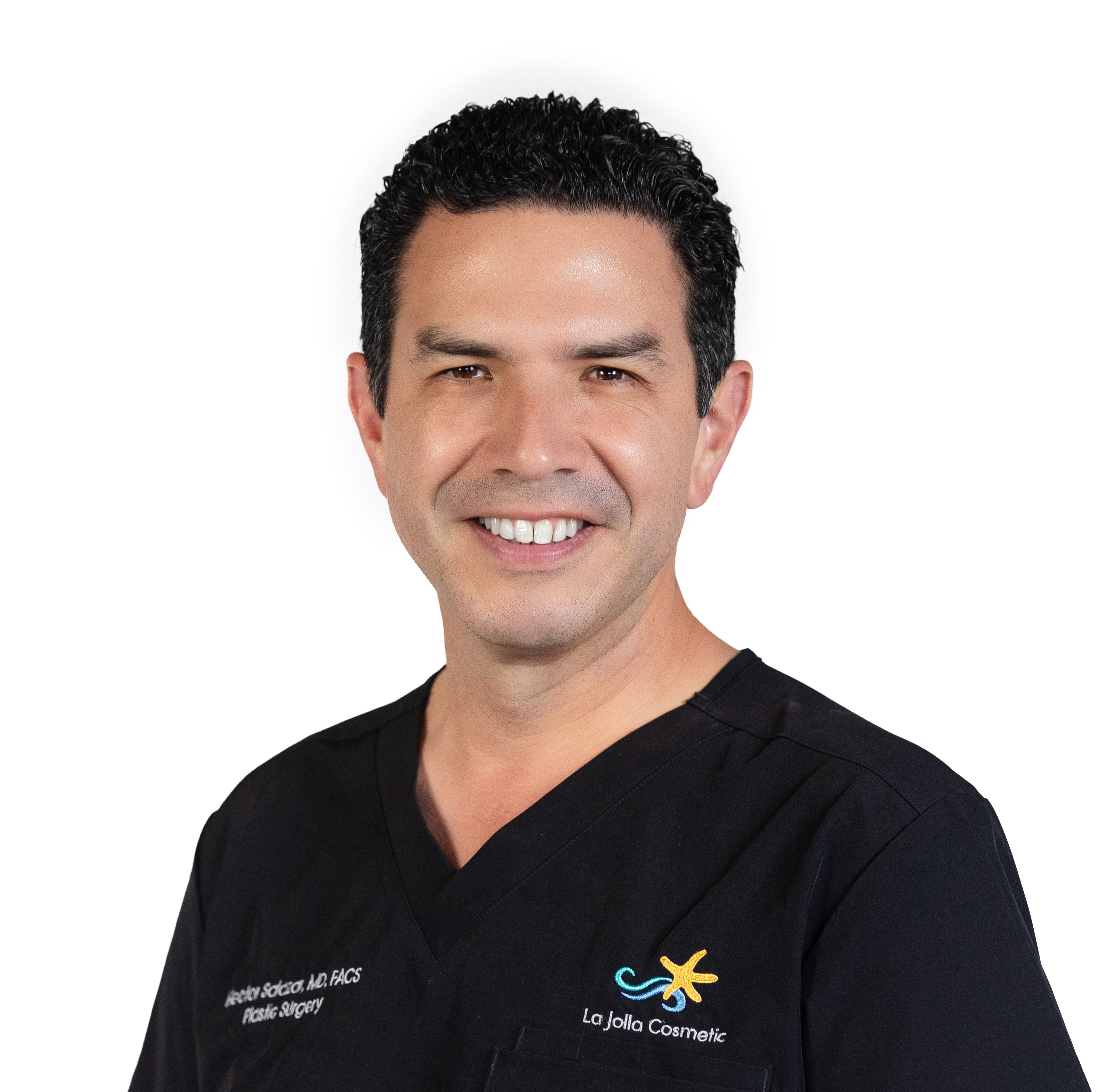
Plastic Surgeon
Having dedicated 17 years of his life to achieve the best medical training, Dr. Salazar’s philosophy is centered around providing beautiful results safely and ensuring each and every patient feels well cared for from their first appointment to their last.
In addition to being an American Board Certified Plastic Surgeon, Dr. Salazar is a member of the American Society for Aesthetic Plastic Surgery (ASAPS), a prestigious organization that is highly selective with its membership. Only plastic surgeons who demonstrate a high level of skill, experience, and expertise in aesthetic plastic surgery and cosmetic medicine are inducted into ASAPS.
Dr. Salazar is also a Fellow of the American College of Surgeons, an active member American Society of Plastic Surgeons, American Board of Plastic Surgery Maintenance of Certification Program, California Society of Plastic Surgeons, San Diego Plastic Surgery Society and the American Medical Association.