


Are Motiva breast implants living up to the hype? When San Diego plastic surgeon Dr. Diana Breister first started using them, they were brand new to her. Now that they’ve become part of her regular go-to, she’s back to share the results.
She talks about what makes Motiva implants different, from their softer, more natural feel to the innovative Monobloc technology that helps them move and settle more like real breast tissue.
Hear how patients are responding so far, how she chooses between Motiva’s Round and Ergonomix shapes to get the right look, and why personalization matters so much in breast augmentation.
Links
Learn more about breast augmentation
Meet La Jolla plastic surgeon Dr. Diana Breister
Book a consultation with Dr. Breister to learn more about Motiva
Learn from the talented plastic surgeons inside La Jolla Cosmetic Surgery Centre, the 12x winner of the San Diego’s Best Union-Tribune Readers Poll, global winner of the 2020 MyFaceMyBody Best Cosmetic/Plastic Surgery Practice, and the 2025 winner of Best Cosmetic Surgery Group in San Diego Magazine’s Best of San Diego Awards.
Join hostess Monique Ramsey as she takes you inside LJCSC, where dreams become real. Featuring the unique expertise of San Diego’s most loved plastic surgeons, this podcast covers the latest trends in aesthetic surgery, including breast augmentation, breast implant removal, tummy tuck, mommy makeover, labiaplasty, facelifts and rhinoplasty.
La Jolla Cosmetic Surgery Centre is located just off the I-5 San Diego Freeway at 9850 Genesee Ave, Suite 130 in the Ximed building on the Scripps Memorial Hospital campus.
To learn more, go to LJCSC.com or follow the team on Instagram @LJCSC
Watch the LJCSC Dream Team on YouTube @LaJollaCosmeticSurgeryCentre
The La Jolla Cosmetic Surgery Podcast is a production of The Axis: theaxis.io
Theme music: Busy People, SOOP
Announcer (00:00):
You're listening to The La Jolla Cosmetic Podcast with Monique Ramsey.
Monique Ramsey (00:05):
Are Motiva breast implants living up to the expectations? Last time we had Dr. Breister on the podcast to talk about them, they were sort of relatively new to the market and relatively new to our practice. And now that she's been choosing them regularly, she's here to let us know how she's liking them, how our patients are liking them. And so we'll dive right into that. Welcome back, Dr. Breister.
Dr. Breister (00:28):
Good morning. Thanks for having me. I'm excited to be here today.
Monique Ramsey (00:32):
Good. Well, happy new year. So yeah, last year Motiva hit the market. It was sort of like all the talk and everybody was learning about them and starting to use them. They'd been used outside of the US for like 13 or 14 years, but it was new to the US. So we were in the testing out phase and now that you've done a lot more cases with Motiva, tell us your honest verdict.
Dr. Breister (00:59):
Well, I've been using them since March of last year and I have just counted my cases. I've done about 50 so far. So I think that's quite a few. And I am really, really liking the implant. I do believe that it feels a step up. It feels like new technology. It feels better, I do believe, than implants of the past. I've been so far extremely happy with how they've been performing and how they've been looking and how they've been feeling. And the patients have been pretty excited about it too. I've had some really great feedback and great results. So far so good. I'm very encouraged.
Monique Ramsey (01:44):
Did you think when they first came out like, okay, it's a new implant, all implants are kind of the same, like maybe it's all just marketing. And then now that you've put a few in, do you see like maybe there is a difference?
Dr. Breister (01:56):
Yeah. Well, there's always going to be a little bit of that. An implant is an implant, but as I've worked with them and as I feel them and as I've really experienced them, I do think there is something different that stands out and is an advancement in the world of implants. And it's hard to express it into words, but the feel of the implant is markedly different than the others. There's something about the way the shell interacts with the gel. And in fact, it's really this monoblock technology where the shell is essentially fused to the gel of the implant. It's a six generation gel. The gel has also been improved and is like the highest generation. It's more elastic. It's viscoelastic properties are higher than any other. So there's an obvious feel to the implant that is very much improved. And I feel that as I handle it, as I place it into the breast pockets, it does feel improved.
(03:02):
So I do believe it's not just hype or it's not just good marketing. I think that there are some tangible advancements that I can see, I can feel, I can tell. Now, the real proof will be in the longgevity of these and that's less than a year now. So they're great so far and that's a really good start, but the proof or the science and the data is going to have to play out over a couple years here to get ... That's really where the advances will be, is if in five years or 10 years we still stick to this very low capsular contracture rate and still low rupture rate, then that's going to be really, really exciting.
Monique Ramsey (03:56):
Now I want to go back to what you said about the shell and it's like ... So I'm guessing, and I could be wrong, that previous or other types of silicone implants, there's a shell that's made out of silicone and then they fill it up with the gel. And are you saying this is all sort of one unit where the edges of the Motiva implant are part of the-
Dr. Breister (04:25):
Yes. Yes. The way they describe it, and at some point I'm going to be headed down to Costa Rica to see how they're made, which is super exciting. I'm super excited to do that, but that viscoelastic gel is essentially one with the shell. They call it monoblock technology.
Monique Ramsey (04:44):
Now, are your patients feeling ... Once the implant's gone in them, of course they wouldn't know maybe the difference between if they have an Allergan implant or they have Motiva. But when you talk about the feel of it, from your point of view as you're placing them in, do they also feel like as you're seeing the patient in postoperative and follow-ups, do they feel different in the patient?
Dr. Breister (05:09):
So that's a tricky thing to discern, obviously. A woman has some breast tissue or not a lot breast tissue, and that breast tissue covers over kind of like a blanket. Some women have a thin blanket. Some people have a down blanket that are covered over the implant. So how you feel that can be a little bit different. But the biggest difference I see in when I say feeling the patient is when we put the implants in, usually over the course of three weeks, six weeks, you can start to kind of feel how the body's reacting and the body creates a reaction to the surface of the implant. And I have noticed that the implants, that shell that's forming seems to be a lot softer than implants of the past. I could sense a little bit of that body forming the scar or the shell around it sooner than I notice it now. So I see the patients at six weeks, three months, and oftentimes I'm like, "Wow, these are so soft." And that's different.
(06:28):
In fact, I had a standard of placing all of my patients if they choose to go on a anti-inflammatory type medication, it's called Singulair. It can help to decrease the amount of capsule. And as a standard, I'd recommend they use it for three months to prevent any undue capsular contracture. So I seem to be consistently at one month or two, I'll be stopping that Singulair because it's very soft and I just don't think there's a need to have it be really any softer. That's different.That's something that I can really quantify and say that I feel like initially putting them into the body, the body reacts with less inflammatory reaction. So that's exciting. And the implant was really designed to do that. They have created an implant that is supposedly the most biocompatible with our body. The surface of the implant is four microns of texture, if you will.
(07:41):
It's not really texture, but that four microns is supposed to mimic our body's same type of texture. So with like and like, it shouldn't react really. What our bodies do is they react to something that's not the same.
Monique Ramsey (07:57):
Well, it sounds like it really is something different than what we've had before. And do you ever have a situation ... Do you recommend to your patients which implant or do you let them choose or do you ...
Dr. Breister (08:13):
You mean which Motiva implant?
Monique Ramsey (08:17):
Right. Well, which Motiva or do you ever still might say, "Okay, Natrelle is maybe better for you for whatever reason."
Dr. Breister (08:24):
So I like to present the information. I think Natrelle is an amazing implant still. I think it's got really, it's state of the art in its own way. So I like to present both options to patients. I mean, I say that right at this moment, Motiva seems to be my preference because of these things I've already talked about, but I tell them to do a little bit of research on their own. I want them to feel comfortable. I don't want them to feel like I'm selling them. Now, it's well known that someone who's had a capsule before is a higher likelihood to have a capsule again. So I will definitely steer them towards the Motiva because it's always good to try something different if you've got a capsule already. There are other options for that too, but it's beyond the scope of this talk, but I will kind of guide them in that direction.
(09:17):
So I like to give them the information and tell them my thoughts, but kind of let them ... I think women are pretty savvy these days. They really do their research. I trust women's gut. There's still plenty of women that come in and say, "I want saline." And I don't argue with that at all. I say, "That's a good choice for you. You want that? " That works. Now, unless they were incredibly thin, I will tell them the downfalls of saline. But like I said, most women really have a good sense of what they want in their body and they've done a lot of research on it. So I tend to want to trust their gut feelings and guide them in a gentle way with science and that sort of thing.
Monique Ramsey (09:59):
Right, right. And so what would you say is maybe the most pleasant surprise now that you've used these for coming on a year?
Dr. Breister (10:08):
Well, the thing that I was most drawn to this implant is because of this surface for microns, it has been shown that there's a less degree of encapsulation when that implant is placed on top of the muscle. That gives us an entire new world of options in breast implants. Not every woman can go on top of the muscle, nor should they, but there are a lot of women who can. And if so, there are advantages to that, to that pocket placement. Number one, you're not going to have any kind of animation deformity, meaning the muscle's not going to pull that implant in any way, shape, or form. Number two, it's less painful because if you're not dividing the muscle, that's helpful, less painful. Less bleeding can happen. The muscle's very vascular. So there are several really great reasons to go on top of the muscle if that's possible, if the woman has a body that can support that, if there's enough soft tissue to support that.
(11:12):
So that is my biggest exciting thing about this implant is that it really has allowed me to feel more comfortable in placing that implant on top of the muscle. And I'm watching those patients really carefully just because it's not something we've done that much in the past. I'm doing it more now with this implant. So I have a very keen eye to see how these are going to age with the patient, if they become encapsulated, how that works out. So I'd say that's very exciting that I can offer that option to women. So that's been, I wouldn't say it's a surprise, but it's been the biggest exciting part for me is to be able to say, "Yeah, I think you can really go on top of the muscle safely and it's going to look great."
Monique Ramsey (12:00):
There's two, let's call them designs of the Motiva implant. If you could describe each of them and then maybe who would be the right patient for each of those designs.
Dr. Breister (12:13):
There is the Motiva round, and I should have brought a couple in here to show you guys, and then there's the Motiva ergonomics. So what I would put those into two categories is that the round implant is more round essentially. It's got a little more fullness and holds its shape a little bit better than the ergonomic. Think of the ergonomic more as slightly teardropped so that when you hold that implant on its side, gravity is going to pull some of that gel down to the bottom. So I would say that women who are really requesting a natural, natural, natural result, they really want it just to go seamless with their body and not look any different than a natural breast would. I would steer them absolutely towards the ergonomic. And then the women who really are excited for that upper pullfulness, they want a rounder look in their clothes, they feel like they want an implant that stands up a little more, I would most likely direct it towards the round.
(13:22):
Ultimately, yes, those things like the round or the ergonomic or the dimensions, the higher profile, the lower profiles, those things all matter. They're very nuanced though. It really comes down to size is what I really tell women that if you're going to choose a bigger implant, if we're putting that into a small pocket, it's going to look very round. So it's really about choosing the proper size in conjunction with the round versus the ergonomic versus the profile, the dimension. When Kylie Jenner, I guess, announced her profile and the type of implant, the type of silicone, everyone kind of went nuts and coming in specifically asking for that certain implant and profile and gel and that-
Monique Ramsey (14:09):
Well, and the muscle placement too, right?
Dr. Breister (14:11):
Exactly.
Monique Ramsey (14:11):
Was it like a half and half kind of thing?
Dr. Breister (14:12):
Yes. Yes. I think she mentioned the dual plane, which most subpectorals are a dual plane in a sense. So most women are getting that, but it brings that nomenclature.
Monique Ramsey (14:25):
Right. She brought a bunch of attention to something that maybe most people wouldn't have thought about.
Dr. Breister (14:30):
And that's good because it's just more education and that gives us an opportunity to have those discussions and makes people happier so they understand what they're getting. But yes, so we have a lot of those discussions. First, you want to decide what you want to look like. Next, you want to decide what's going to be the best pocket on top or under. Then we're going to decide what they want to look like in the cleavage area. Do they want to be a little more natural? Do they want to be a little more full? And then overall, just what size matches their body, what is going to balance them out, match the shape of their hips, how broad their shoulders are. I like to really have the patient try on different sizes so that they can see that how that interacts with their whole body, not just about looking at two boobs on a body. You want to really look at the whole body and how that interacts. And so-
Monique Ramsey (15:33):
And how it feels probably too. Like to say 350 ccs means nothing until you actually try them on and go, "Oh, is this my test drive? I'm taking it for a test drive."
Dr. Breister (15:45):
What does that mean? What does that volume, what would 200 look like on me? So there's a lot of nuances in determining the proper implant size, placement, all of those things. But Motiva has definitely given us or given me, given patients a lot more options that we didn't have before.
Monique Ramsey (16:07):
Now, patients hear a lot about implant safety online and there's probably way too many rabbit holes that they can dive down. So what would you say about Motiva's, what they talk about implant safety from their technology standpoint or how they've addressed that?
Dr. Breister (16:27):
Well, when you mean safety, are you more asking about encapsulation or rupture or inventory?
Monique Ramsey (16:35):
I think maybe rupture is one thing that ... Well, yeah. Okay. Well, that's good too. I was thinking about rupture, but implant illness might also be something that people are worried about.
Dr. Breister (16:46):
Well, the implant illness I think is going to be hard to pinpoint on one exact implant per se. Breast implant illness is a body's reaction to a foreign body. So whether that foreign body is an Allergan implant or a Motiva or a Cientra, it's the body's reaction to that. So I don't know if there's any way to prove safety in one device over the other to safeguard against that. Breast implant illness is very much hard to pin down exactly which one. So with that, I don't know how we would differentiate that from others. I don't think anyone could sit there and claim, "Listen, you won't get breast implant illness." However, the company is, they stand by their product in that if a woman decides they don't want the implant, there is a policy they have that they will either contribute or cover the cost of removing the implant.
Monique Ramsey (17:46):
Oh, really?
Dr. Breister (17:47):
Yeah. So that's kind of their, I guess, safety or safety insurance against if you don't like it. I guess if you just don't like the implant or you feel like you're developing breast implant illness, they'll stand by it to remove it. So there's that one aspect of it. And then as far as safety, I think the monoblock technology, that shell that's essentially fused, I think that is going to ultimately over time have a much less incidence of rupture because we do know that when the implant buckles on the edges and there's friction and the two surfaces are kind of rubbing together, that can lead to implant shell weakness. So if there's less of that, less buckling, less friction, less incidence of rupture, which is what they've seen in Europe. So that is more safe, obviously. And then with that four micron surface that is the most biocompatible implant available, that should lead to less inflammation, less capsule.
(18:56):
So less capsule is really the holy grail. If we could not ever get a pathological capsule, if you will, then that-
Monique Ramsey (19:05):
The thick, hard.
Dr. Breister (19:07):
Right. Everyone's going to develop some sort of capsule that's normal, but we want that capsule to be soft.
Monique Ramsey (19:14):
Last question. There's that 10 year, not warranty, but they kind of say, okay, the lifetime, it's not a lifetime device. An implant is not a lifetime device for a breast. So is the 10 year school of thought kind of the same for-
Dr. Breister (19:35):
The 10 year kind of urban legend, if I call it, is completely out the window for any implants in my mind. Okay. I think that at five years, women should start monitoring their devices. And I recommend a high resolution ultrasound for that. Once they do that, they can repeat that every several years. If there's no visible problem they feel within their implants, I believe it's safe to keep them in beyond 10 years and well beyond 10 years if those things check out. So Motiva or Allergan or saline, whatever it is, I think a high resolution ultrasound starting at three to five years is the way to go in making sure that your implant is intact.
Monique Ramsey (20:26):
We have that at our office, right?
Dr. Breister (20:28):
Yes.
Monique Ramsey (20:29):
Is it the same? Yeah.
Dr. Breister (20:30):
Yeah. Yeah.
Monique Ramsey (20:32):
Okay. Just for people so that they know, we offer that as a procedure in the office. It takes, I think like 45 minutes or so. And I think some women just want that peace of mind. It's a smart thing to do per your point, but it's also, you never want that niggling thought in your head like, "What's going on in there?"
Dr. Breister (20:56):
And some women, I had a patient not so long ago, she had them for 10 years or 12 years and some women, even if there's not much going on, they want to replace them. And I don't think there's anything wrong with that either. As women, we know our bodies, we know what bothers us, we know what feels right. And in some women, replacing them after 10 or 12 years just feels right to them. And I can't argue with that either.
Monique Ramsey (21:24):
This has been a great discussion today, Dr. Breister, because when it all started, it was the unboxing and you saw just video after video of surgeons, "Oh, here's my unboxing the Motiva." And it was sort of this trendy thing that everybody's talking about and for good reason because we hadn't had a new-
Dr. Breister (21:46):
We haven't had any really new technology for 12 years. So it is kind of exciting to know that there is something different and to now have used it, had done 50 cases. Like I said, I'm still encouraged. I'm excited. I don't think it was a lot of fluff. I think there's some hard science behind what has made these implants superior. Now it's a matter of just continuing to use them and continuing to monitor them and following them over time. But I'm very encouraged. I love using them. I do really truly believe I'm using something that is higher technology. I heard someone use an analogy, an iPhone six versus an iPhone 17 or whatnot. Things evolve. Things do evolve in all facets. We get more educated, more science. And this is really exciting because of how many women do enjoy breast implants and it's great innovation.
Monique Ramsey (22:47):
Right. Well, when are you going to Costa Rica?
Dr. Breister (22:50):
I have offers a couple times and just things didn't work out, but yeah, hopefully soon. I'm excited to meet the owners. And I'm really excited to see it, to see how the implant's made. But no, I've never been to Costa Rica.
Monique Ramsey (23:01):
Oh my gosh. I love Costa Rica. I'd go back in a heartbeat and it's such a clean, gorgeous country. And then to be ... Oh, you're going to love it. And then I think to be able to go to where they've developed this implant and like be boots on the ground at ground zero, I think is very cool. So I'm going to ask you whenever you go, please take a lot of pictures and video because I would love to have you back on the podcast and really like, we could do a screen share and I can show-
Dr. Breister (23:29):
That'd be fun.
Monique Ramsey (23:30):
Yeah. Show kind of, you can walk everybody through what you learned when you were there because I think that's a very once in a lifetime kind of thing.
Dr. Breister (23:37):
That'd be cool.
Monique Ramsey (23:38):
All right, Dr. Breister. Well, for everybody listening, if you have any questions, it's free to talk to us. We don't charge you to talk to us. So we'll put links in the show notes of how to set up a consultation if you're interested in that. Maybe you're thinking about breast implants, maybe you want to change out the ones you already have in or anything else. Dr. Breister is so accomplished. She has beautiful facial surgery and I mean, it's not just breasts. So she'd be happy to talk to you about whatever you're thinking about. And we'll put all those links in the show notes. And thanks again, Dr. Breister.
Dr. Breister (24:12):
Thank you, Monique,
Monique Ramsey (24:12):
For everybody listening and we'll see you on the next one.
Dr. Breister (24:15):
Okay, sounds good. Bye. Bye.
Announcer (24:20):
Take a screenshot of this podcast episode with your phone and show it at your consultation or appointment or mention the promo code PODCAST to receive $25 off any service or product of $50 or more at La Jolla Cosmetic. La Jolla Cosmetic is located just off the I- 5 San Diego Freeway in the Ximed Building on the Scripps Memorial Hospital campus. To learn more, go to ljcsc.com or follow the team on Instagram at LJCSC. The La Jolla Cosmetic Podcast is a production of The Axis, T-H-E-A-X-I-S.io.
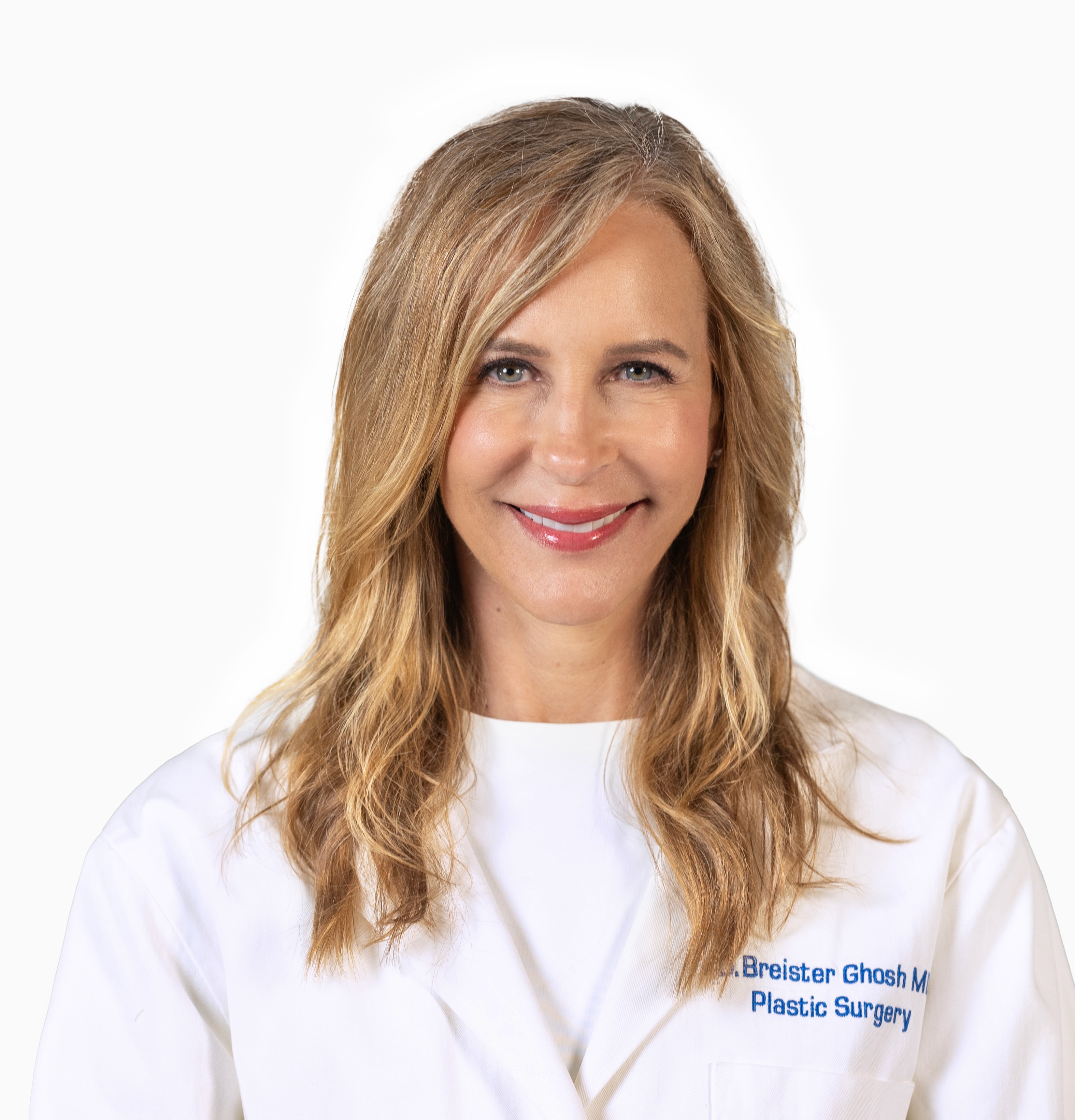
Plastic Surgeon
Practicing in a field that focuses on beauty and confidence for over 20 years, Dr. Diana Breister has become fluent in understanding the general self-image of women. Though she is skilled at several types of procedures, she is most known for her excellence in doing face and neck lifts, eyelid surgery, feminine rejuvenation, breast augmentation, breast lift, and tummy tucks. With a specialization in skin loss removal, she’s passionate about helping people who have lost weight become less self-conscious about the loose skin left over.